By Isabelle Renee Y. Villanueva | August 26, 2026

A New "Town" Is Coming
By Isabelle Renee Y. Villanueva | August 26, 2026
THE Philippines is taking another step toward developing its own space capabilities, with the planned launch of the country’s first liquid-fueled sounding rocket in early 2027. Announced by President Ferdinand Marcos Jr. during his recent State of the Nation Address (SONA), the launch is expected to take place at Cagayan North International Airport in Lal-lo, Cagayan.
The planned launch is part of a broader effort to develop the skills, systems, and infrastructure needed for rocket testing and future space activities. Rather than serving as an isolated demonstration, the launch forms part of a broader effort to build the country’s capacity.
Beyond a Single Project
The Philippine Space Agency (PhilSA) is the government agency responsible for the country’s space program, including space research, technology development, and industry growth. As the country looks beyond its first launch, the development of a spaceport could provide the infrastructure needed for future launch activities and operations.
PhilSA identifies Cagayan as a suitable location because of its proximity to the Pacific Ocean and the equator. Its location near the Pacific provides open waters for rocket launch and recovery operations, while its proximity to the equator allows rockets to take advantage of the Earth’s rotational speed for more efficient launches. The agency is also pursuing a public-private partnership for the long-term development of the Philippine spaceport and future commercial rocket launches.
Science Behind the Launch
Sending rockets carrying scientific instruments into the atmosphere allows researchers to collect data and conduct experiments. Liquid-fueled rockets use liquid propellants that are mixed and burned in an engine to produce the thrust needed to lift the rocket. Developing and testing this type of system requires expertise in propulsion, materials, aerodynamics, guidance, control systems, and launch operations, giving Filipino engineers and scientists practical experience with the systems needed for future launch vehicles.
The launch could also provide a platform for experiments and technology demonstrations. Instruments carried by the rocket could collect data from the upper atmosphere, while researchers could test equipment and technologies under actual flight conditions. Each test can provide information that engineers can use to improve future designs.
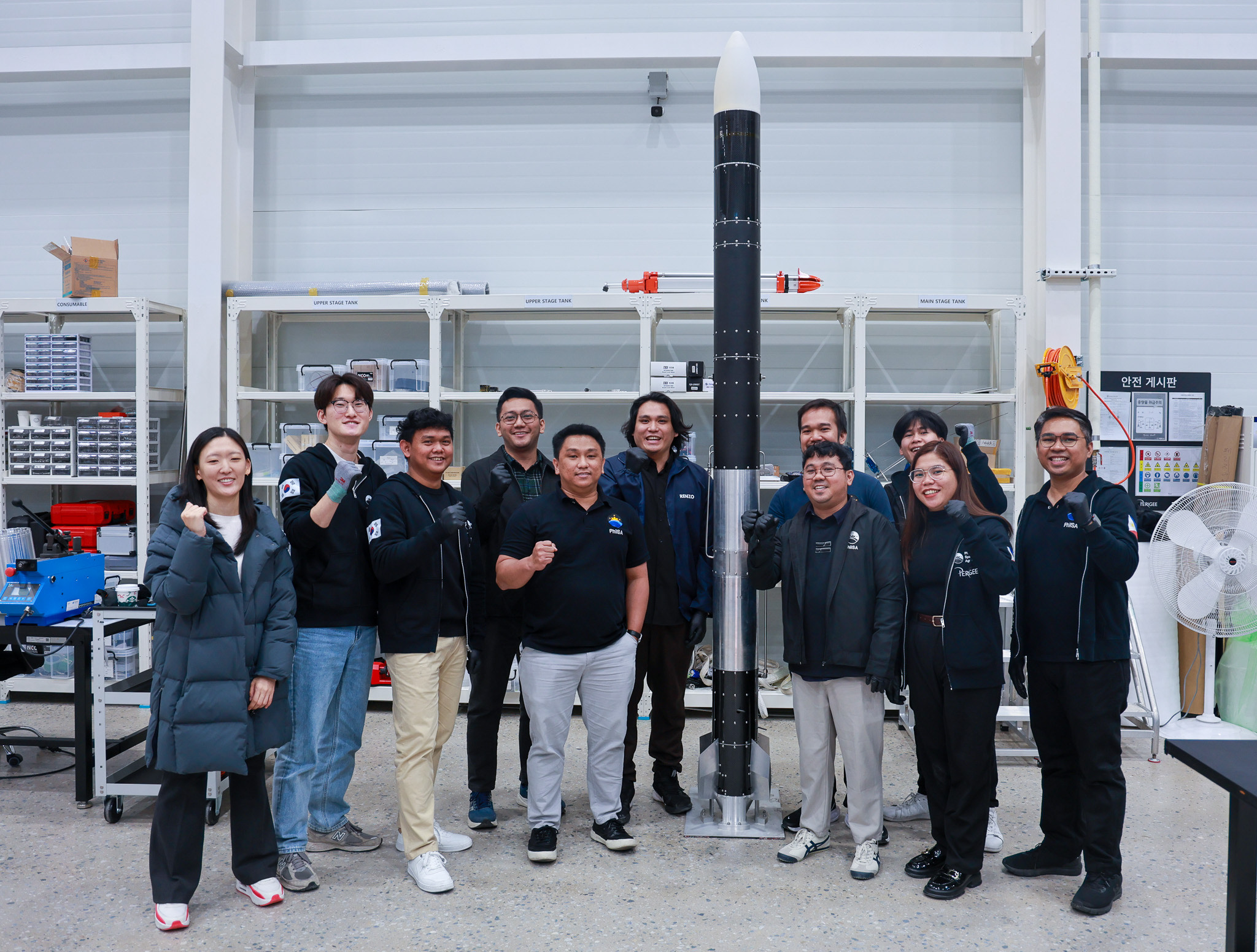
Behind this progress is a collaboration with Perigee Aerospace, a South Korean space mobility company that develops launch vehicles and propulsion systems. Beginning with a 2022 memorandum of understanding, the partnership has brought Filipino engineers closer to the technology behind sounding rockets through hands-on training in South Korea.
Selected engineers studied rocket theory and worked directly with Perigee’s Blue Whale 0.1 liquid-propellant sounding rocket, gaining experience in its assembly and development. The training continues through a second phase focused on rocket assembly, system integration, testing, and launch preparation, allowing Filipino engineers to become more familiar with the processes behind bringing a launch vehicle closer to the launchpad.
Through PhilSA’s collaboration with South Korea’s Perigee Aerospace, Filipino engineers gain hands-on experience with sounding rocket systems. As the country expands its involvement in the field, it could develop its own expertise and workforce in rocket and space technology rather than relying heavily on foreign companies and launch facilities. PhilSA's 2025 annual report highlights training efforts aimed at strengthening the national space workforce and building technical capabilities, including groundwork for future local assembly, testing, and launch operations.
Having a local launch facility could make it easier for Filipino researchers, universities, and institutions to participate in experiments and technology demonstrations that require rocket launches.
Despite developing a sustainable spaceport will require local expertise, advanced technology, safety systems, long-term funding, and continued cooperation with international partners. As described by PhilSA, the Cagayan project is a step toward becoming a gateway to space and preparing for future launch activities.
When Space Feels Closer
For years, space technology has been something Filipinos encounter from a distance, through satellites, foreign space missions, and technologies developed outside the country. Now, Filipino engineers are being trained to work directly with the systems behind a liquid-fueled sounding rocket, preparing for a launch on Philippine soil. This shift is subtle but significant: the people working toward the launch are no longer simply looking toward space from the outside, but learning how to build a place for the Philippines within it.
That change matters beyond the engineers themselves. A student interested in science can look toward a field where Filipino professionals are actively building experience, while an ordinary Filipino can see the country participating in an industry associated with nations with much longer histories in space exploration. The rocket becomes more than a technological project; it becomes something Filipinos can point to and say, “we can do that too.”
For a country that has traditionally relied on other nations for access to space technology, developing local launch capabilities represents more than technological progress. It challenges what Filipinos may see as possible. A student who sees Filipino engineers working on rockets may begin to imagine a career in aerospace, while a researcher may find new opportunities to pursue work that once seemed inaccessible at home.
Not everyone will understand the science behind a rocket or work in the space industry, yet its significance extends beyond the rocket: it represents the Philippines establishing its own presence in a field dominated by technologically advanced nations. It reminds Filipinos that they, too, can create, innovate, and claim places in spaces that once seemed beyond reach.