By Haniel Mizukami | August 6, 2026

Unweaving Threads of the Forgotten Burdang Taal
By Haniel Mizukami | August 6, 2026
IN an age dominated by fast fashion and machine-made products, handmade Filipino crafts remain enduring symbols of patience, artistry, and tradition. From woven textiles to intricately embroidered garments, these creations embody skills passed down through generations. Yet while some traditions continue to flourish, others are quietly fading into obscurity, including Burdang Taal, a century-old embroidery tradition whose legacy now hangs by a thread.
Story Behind Every Stitch
Like threads woven through time, the legacy of Burdang Taal is stitched in our history. As early as the first decades of the 1900s, tracing back to the Spanish colonial period, hand-embroidery was widely practiced, particularly from Taal, Batangas. Using fabrics such as piña (pineapple leaf fiber, prized for its translucence and stiffness) and jusi (a silk-cotton blend, usually more affordable than piña), clothes from Taal were embroidered in calado designs, a hand-pulled threadwork that creates lace-like patterns, often seen in clothing worn during the early 20th century.
Piña fabric and calado embroidery are best known for their use in the Barong Tagalog, where delicate textiles and intricate needlework enhance the garment's elegance. Beyond the barong, piña is also used in other formal attire, long symbolizing refinement and prestige in Filipino clothing.
This tradition from Taal dates back to 1916, a time period when many women were already engaged in needlework. By the 1920s and 1930s, Burdang Taal had become a recognized craft in the Philippine fashion industry.
Hands Behind the Craft
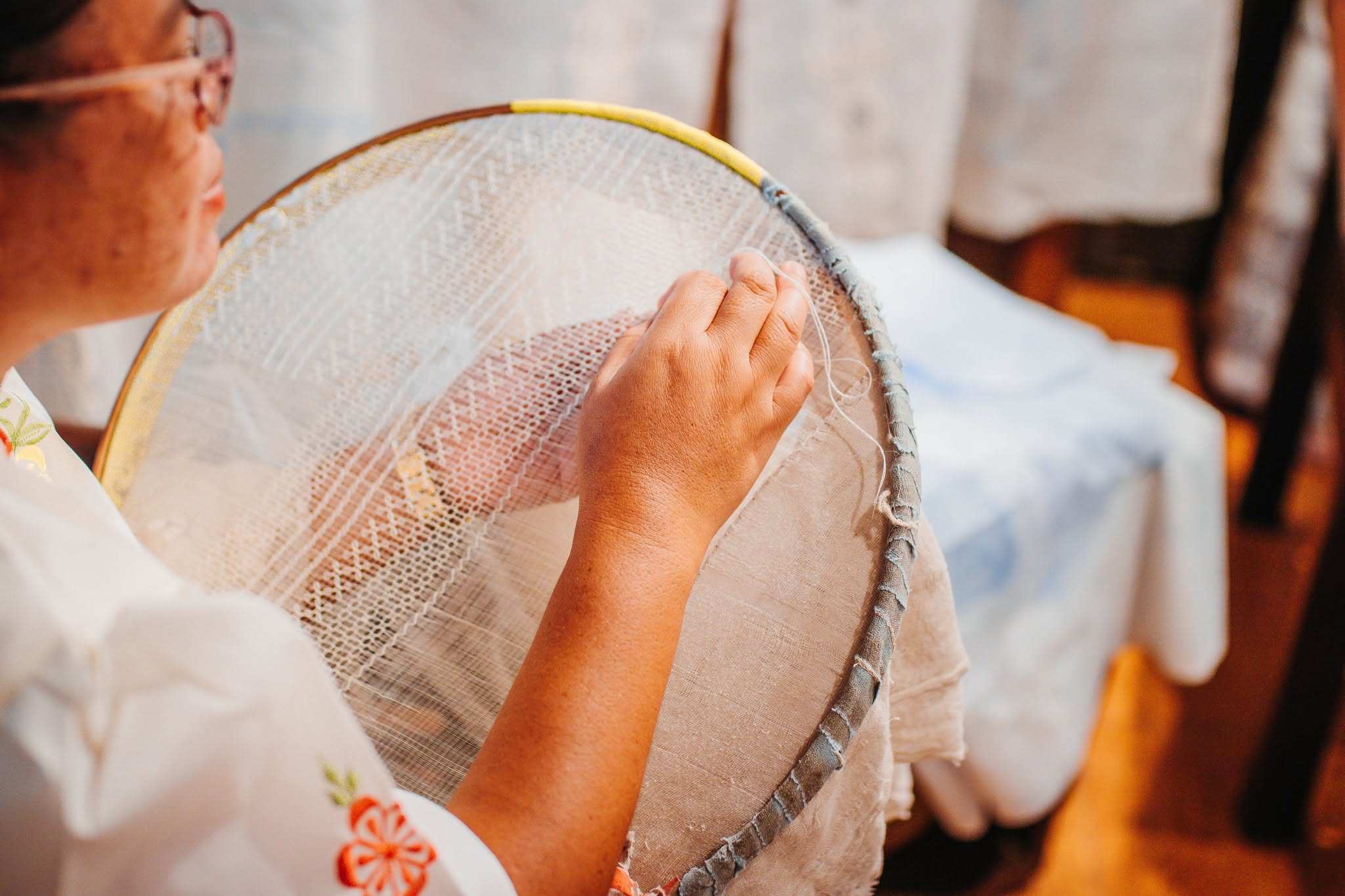
Burdang Taal unfolds through a multi-step embroidery process. The bordaderas, or female embroiderers, worked with precision; often without thimbles, as they carefully pulled threads to create delicate openwork and stitched floral and geometric motifs. Through their meticulous craftsmanship, they produced textured, relief-like embroidery that defined the character of the tradition.
The craft also followed a specialized division of labor. The magdidibuhos, or designers, create embroidery patterns. The magbuburda, or embroiderers, brought these designs to life through needlework, while the magkakalado, the artisan, together with their helpers, executed the intricate openwork. Each finished piece was then carefully washed, sun-dried, and prepared for sale, reflecting the collective artistry and elaborate process behind every creation.
Unloosing the Thread
Despite recognition in the fashion industry, the artistry of the tradition began to decline by the 1960s. Machine embroidery and the emergence of cheaper synthetic fabrics weakened demand for labor-intensive handwork. Due to this, many artisans left the craft in search of less time-consuming livelihoods.
By the 2010s, Vera Files, a nonprofit independent media organization that probes into current Philippine issues, and an article by the Inquirer had identified several factors behind this decline: increasing market competition, seasonal demand, challenges in securing business permits, and limited access to capital and raw materials. These barriers made it difficult to sustain the craft.
In a July 2026 article by Rappler, several women shared why they continue practicing Burdang Taal despite the craft’s steady decline. Among them was Mary Jane Marcellana, who recalled how handmade embroidery was once the preferred choice, even after machines had already been introduced.
“Back then, machines did exist, but people still prioritized buying our craft,” she said.
Today, however, factory-produced barongs have become more accessible and affordable, leading many customers to choose machine-embroidered garments over handcrafted pieces. As a result, machine embroidery now dominates the market, while demand for hand-embroidered pieces continues to decline.
For a lot of embroiderers, the craft they create is their life.
“This is the cultural pride of Batangas. If we stop doing this, we will also stop being ourselves,” said Dorina, one of the women interviewed by Rappler.
Where the Threads Lead
How do you preserve an art that is slowly losing its threads?
As fast fashion and mass production continue to reshape the textile industry, the future of Burdang Taal no longer rests solely in the hands of its remaining artisans. It also depends on consumers, designers, institutions, and younger generations who choose to preserve its value.
“We need more people to learn this craft,” expressed Lorenza, one of the few remaining bordaderas for Burdang Taal. “Even with failing eyesight and shaking hands, I will continue doing this.”
Although the local government and cultural agencies have taken their course of action by promoting the tradition through exhibitions, heritage tourism programs, and cultural events that showcase the crafts, it does not guarantee the future of the art, as awareness alone is not enough.
Expanding its training programs and creating spaces where the youth can learn the craft can help preserve the dying art of Batangas. Because for the women in Taal, embroidery is a legacy that is stitched together with patience, resilience, and generations of inherited skill.
Though the threads of the Burdang Taal may have begun to unravel, they have not been cut. As long as the hands of the future generation are willing to value the stories woven through every stitch, the tradition will continue to endure; not just a work of art, but as a testament of our Filipino heritage.