By Jannica Faith Tan| August 17, 2026

The Architecture of Accessibility
By Jannica Faith Tan| August 17, 2026
WE talk about the cost of education in thousands of pesos, often assuming that financial constraints are the only thing that separates a student from a classroom. But what happens when the barrier isn't a bank account, but a learning space that is not designed for accessibility?
For most students, a conducive learning space is one where they can thrive without dreading next month’s statement of account. It is a space where the quality of education isn’t compromised by financial accessibility.
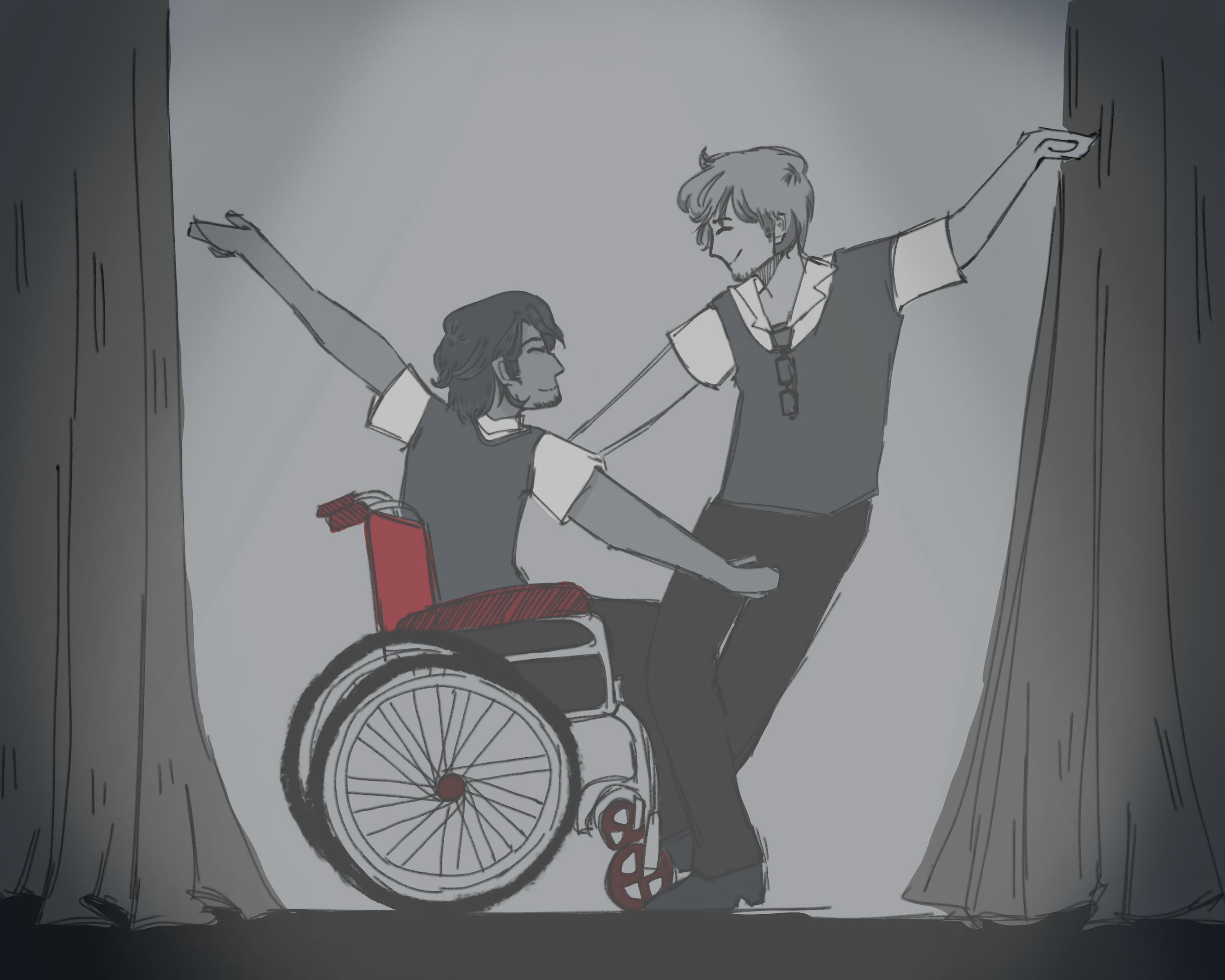
Sometimes, it is an environment that fosters creativity and offers a university experience that exists outside the curriculum. They worry about the people they’ll encounter — the friends they may or may not make, and the professors who will shape their minds. For a student with a disability, these are luxuries. Before the anxiety of making friends and passing a class sets in, they think about the difficulties they might face in simply navigating the campus as easily as their peers do. And when basic access is treated as a luxury, education inevitably becomes one too.
The success of a university isn’t just measured by its yearly number of graduates, or how many board passers, doctors, and lawyers it produces. True success should also be measured by how intentionally it makes room for those who cannot simply walk up the steps of a traditional campus.
Benedictine Hospitality and Inclusive Education
SBCA creates an inclusive space by committing to the Benedictine value of Hospitality and Community. It is a principle that values each student’s similarities and differences and ensures everyone is received with compassion and respect regardless of who they are.
True accessibility is a constant work in progress. Creating physical architecture is a challenge. Ensuring that inclusivity isn’t reduced to a feature of the campus, but becomes a quality that lives within the students themselves. SBCA’s School of Arts, Sciences, and Education (SASE) works toward this through programs that align directly with the international Convention on the Rights of Persons with Disabilities.
By focusing on special educational needs, SBCA aims to make Filipino education more inclusive—producing graduates who will serve as specialized educators, consultants, and advocates. Or simply, graduates who care.
For Carina E. Mata, a student currently enrolled in the Bachelor of Special Needs Education (BSNEd) program, this commitment is deeply personal. Driven by her own experience as a mother of a child with special needs, Ms. Mata views the profession not just as a career, but as a lifelong mission.
“Choosing the Special Needs Education program was never just about the growing demand in the education sector. There is a deep calling within me to serve,” Ms. Mata shares. “I want to become a teacher who creates opportunities for children with special needs to learn, grow, and feel valued.”
Taking the program has reinforced her belief that no student should be left behind, while also opening her eyes to a difficult reality: not all educators in the broader system are currently equipped to handle learners with disabilities. This gap in training often stems from societal misunderstandings about special education itself.
“The biggest misconception people have is that SPED teachers are just 'caregivers,'” she explains. “In reality, they are trained educators who develop individualized learning plans and implement evidence-based teaching strategies.”
Assumptions about students with special needs are just as harmful; “The biggest misconception is that children with disabilities cannot learn,” Ms. Mata points out. “But children with disabilities can learn when provided with appropriate support, accommodations, and teaching strategies. Our role is not only to teach academics but also to foster independence, confidence, and inclusion.”
On a practical level, SBCA also prioritizes PWD students in locker leasing, so their belongings are stored somewhere accessible to them. From curriculum involvement and physical accommodations, SBCA also offers financial assistance to help ease the cost of tuition.
Accessibility is The Key Towards Excellence
The University of the Philippines (UP) has long been known for its rigorous entrance exams. Students across the country begin preparing for the UPCAT years before results are even released. Passing the exams is an achievement, but being given the opportunity to take it is another. For UP, making room for students with disabilities begins before they even set foot in a classroom.
In 2008, the university formalized the Special UPCAT, ensuring that the entrance exam remained accessible to everyone while maintaining its academic standards. At the Diliman Campus, UP provides an exam tailored to the specific needs of each taker: large-print booklets are provided for applicants with low vision, Braille exams for blind students, sign language interpreters, and one-on-one dictated exams. It’s proof that academic merit and accessible design can — and must — coexist.
On the question of mobility, the UP Manila College of Allied Medical Professions addresses the shortcomings of a standard wheelchair through their Wheelchair Service Program (WSP), which semi-customizes a wheelchair to fit each user’s specific medical condition, daily activities, and physical environments. It’s a reminder that accessibility is a universal need, but not a one-size-fits-all solution.
By the Students, For the Students
De La Salle University (DLSU) shows that student-led advocacy can be just as significant as infrastructure in creating an accessible university. Its University Student Government’s Commission on Disability Inclusion (CDI) works closely with university offices to implement practical support mechanisms for students with disabilities.
The CDI prioritizes students with disabilities through early enrollment, allowing them to secure accessible class schedules before general slots fill up. It also provides specialized lanyards that grant access to priority queues in administrative offices and priority use of campus elevators.
Personalization as a Tool
De La Salle-College of Saint Benilde shows its commitment to accessibility through its Center for Inclusive Education (CIE), a dedicated hub offering support tailored to each student’s specific needs. The CIE provides personalized case management and special testing accommodations so no one falls behind because of administrative processes — along with practical resources and services like Braille printers, customized and modified exams, and case managers that help build individual learning frameworks.
Benilde also drives national change through its Center for Education Advancement of the Deaf (Benilde-CEAD). By integrating Filipino Sign Language (FSL) with written literacy and partnering directly with the Department of Education, CEAD trains public school teachers to lower the language barriers Deaf learners face on the way to higher education. It also builds partnerships such as Philippine Normal University to help Deaf educators pass the Board Licensure Examination for Professional Teachers.
The institution’s assistance doesn’t end at graduation, either: Benilde runs placement programs designed to help its students secure employment as they enter the workforce.
People aren’t disabled by their bodies, but by environments that fail to accommodate them.
Creating a truly inclusive educational space requires more than physical infrastructure. It demands the intentional alignment of policy, empathy, and institutional values. When universities improve admission procedures, campus navigation, and academic frameworks, they affirm that every student belongs in the room. Educational accessibility is not a privilege to be granted, but a standard to be upheld. After all, people with disabilities are still people—and every person deserves a place in the classroom.