By Sophia Anillo | October 15, 2026

By Sophia Anillo | October 15, 2026
IN a country attuned to signals of storms and stories of survival, resilience has become woven into the Filipino narrative. Yet, one of the Philippines' most overlooked truths is its natural wealth. The country's natural endowments are increasingly under threat. Palawan's otters are the most recent example of wildlife disappearing beneath the very conditions Filipinos have learned to endure.
Born of Broken Land
Palawan’s otter is part of the island’s distinct wildlife, shaped by its geographic history. A 2001 study by Reis and Garong discusses the region’s biogeography, including the effects of past changes in sea levels. Locally known as the dungon, the Asian small-clawed otter inhabits Palawan. Its distribution and evolutionary history, however, should be explained using sources that specifically establish the species’ presence in the province.
The Asian small-clawed otter is the smallest otter species in the world, according to the Inquirer. Adults have short claws that do not extend beyond their toes, a distinguishing feature of the species. They generally weigh about 2 to 5 kilograms, compared with the smooth-coated otter’s reported weight of 7 to 10 kilograms. The International Union for Conservation of Nature (IUCN) classifies the species as vulnerable, while the Palawan Council for Sustainable Development (PCSD) reportedly lists it as endangered.
The size of Palawan’s wild otter population remains unknown, as researchers have yet to establish a reliable count. The IUCN classified the Asian small-clawed otter as vulnerable in 2015 following a reported decline in its global population. Pollution, hunting, habitat loss, wetland degradation, and illegal capture for the pet and meat trades continue to threaten the species.
While its isolation is old, its documentation is rather new. It was not until 2015 that researchers first filmed the otter in the wild, and even then, the discovery was incidental. As stated in the Journal of Threatened Taxa, researcher Paris Marler and her team encountered the otter while surveying other species in the dense understory of Cleopatra's Needle.
Long before scientists documented the species, communities in Palawan were already familiar with the dungon. Farmers regarded it as a nuisance while fishermen hunted it for sustenance. As reported by the Inquirer, Southern Palawan lost 57,715 hectares of forest from 2001 to 2023, mostly to slash-and-burn farming, the PCSD said.
A Pattern of Rescue and Recurrence
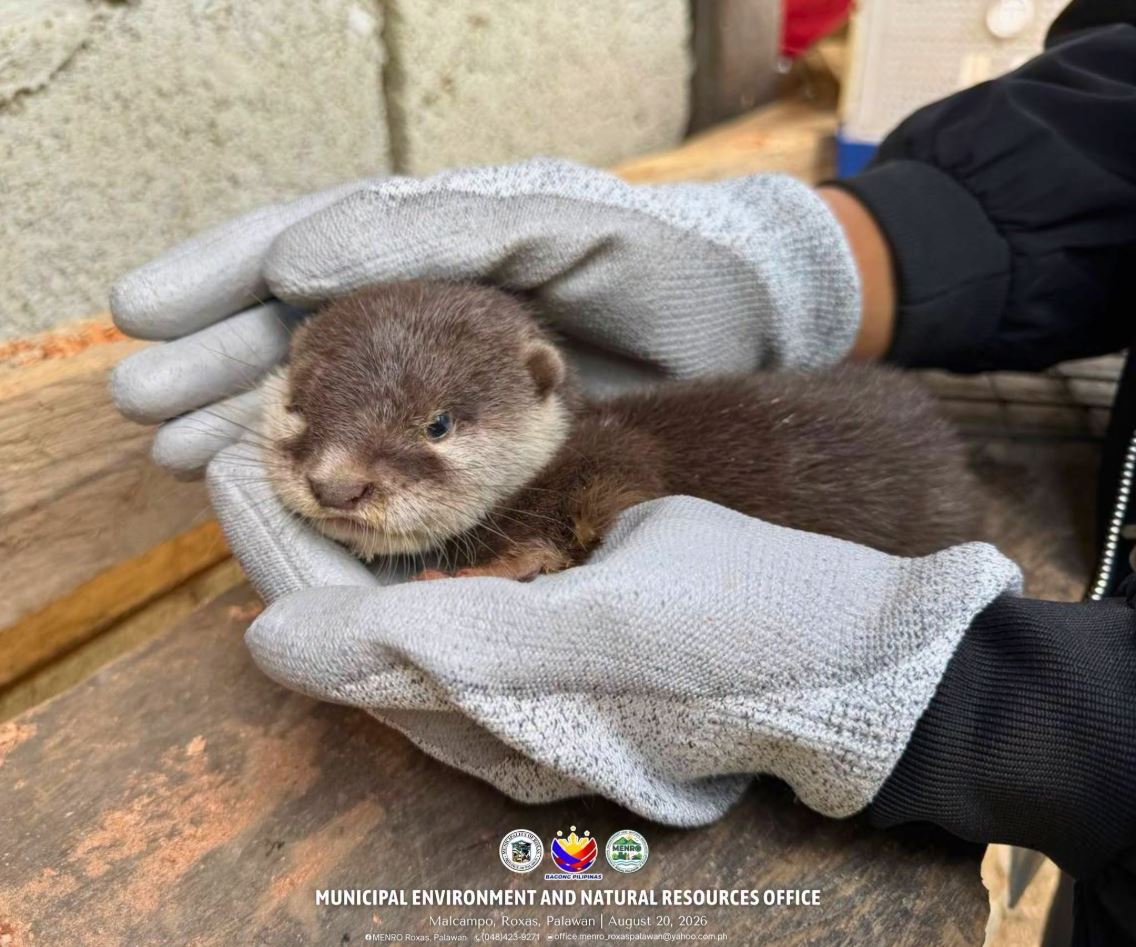
Otters caught public attention once more in 2026. On Aug. 20, motorist Roel Labadia found a juvenile female dungon along a road in Barangay Malcampo, Roxas. As stray dogs gathered nearby, the otter sought shelter beneath his motorcycle. Labadia took the animal home and later coordinated with environmental authorities for its rescue and eventual release.
After a month, on Sept. 12, an adult male dungon, was struck by a vehicle along a highway in Barangay Tagburos, Puerto Princesa. The collision left its hind legs severely injured. On Sept. 13, a concerned citizen brought the injured otter to the DENR Checkpoint in Barangay Sta. Lourdes. The Tribune reported that the PCSD Staff's Wildlife Enforcement Team then took the otter to the Palawan Wildlife Rescue and Conservation Center.
These incidents reflect a growing challenge for Palawan's wildlife. The Palawan Scientist noted that new roads cut through forests and wetlands, and a highway survey found many road-killed birds and mammals. Palawan Wild Frontier adds that otters can freeze under headlights while crossing at night.
While these rescues offer hope, they also highlight a recurring pattern: intervention often comes only after wildlife has reached the road. Land clearing, development, and human expansion fragment forest corridors, leaving wildlife with fewer places to go and forcing them onto highways. Global Forest Watch data show that Palawan’s total tree-cover loss had a big increase between 2022 and 2024. 2022 endured a loss of approximately 202,000 hectares while 2024 endured a loss of 219,000 hectares.
A contributor to this loss is mining expansion. For instance, in July 2025, the Long Point Nickel Project received a permit to mine 2,177 hectares, with production expected to double annually through 2028. Protecting these habitats and improving safety measures on forested roads, therefore, can help prevent future encounters. When prevention fails, prompt reporting can give injured wildlife another chance.
The Other Side of Resilience
Resilience is often celebrated in the Philippines, but protecting the country’s biodiversity requires more than surviving each crisis. Wildlife must be protected before habitat loss and unsafe roads put animals at risk. Palawan’s otters are a reminder that conservation should not begin only after an animal is injured. Protecting wildlife means addressing the threats that endanger it before another rescue becomes necessary.
Palawan’s otters highlight the threats facing the Philippines’ rich biodiversity. From road accidents to habitat loss, their plight underscores the need to protect wildlife before harm occurs. Conservation must go beyond rescue efforts and address the threats that put vulnerable species at risk.
Volume 32 | Issue 4