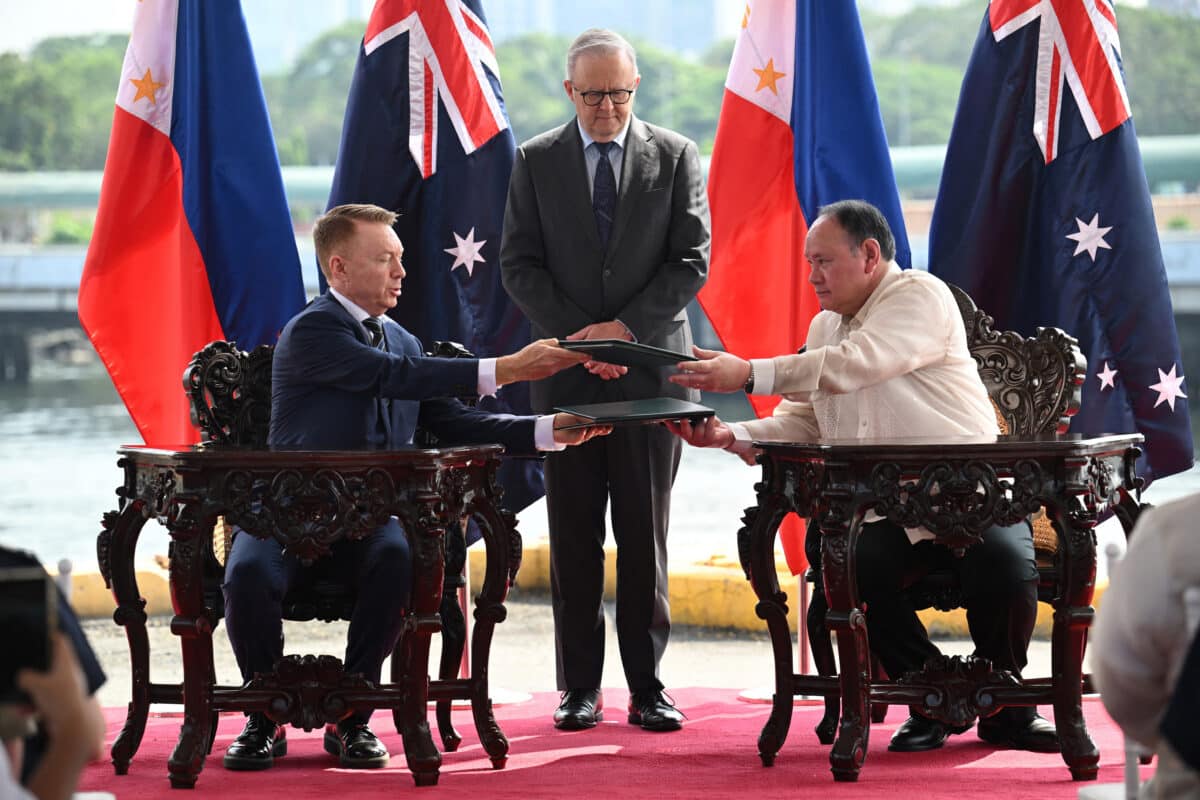
The Philippines and Australia signed an updated Defense Cooperation Arrangement (DCA) on Nov. 15 to streamline military coordination and expand defense cooperation amid tensions in the South China Sea.
Philippine Defense Secretary Gilberto Teodoro Jr. and Australian Ambassador to the Philippines Marc Innes-Brown signed the agreement at the Eva Macapagal Cruise Terminal in Manila South Harbor, with Australian Prime Minister Anthony Albanese witnessing the ceremony.
The arrangement supersedes the 1995 memorandum of understanding on defense cooperation and builds on a statement of intent signed by Teodoro and Australian Deputy Prime Minister and Defense Minister Richard Marles in August 2025. It is intended to streamline procedures and facilitate joint defense activities. Its signing coincided with the 80th anniversary of diplomatic relations between the two countries.
Philippine Army spokesperson Col. Louie Dema-ala said bilateral exercises with Australia have focused on amphibious landing tactics and procedures since 2023. Under the new arrangement, the militaries are expected to conduct more complex exercises involving ground, air, and naval forces as the Philippine Army develops its multi-domain capabilities.
“We are transitioning into a multi-domain capable Army,” Dema-ala said, explaining that the expanded exercises will give Philippine soldiers access to advanced combat instruction while allowing Australian troops to gain operational experience in dense Philippine jungle terrain—benefiting both sides.
Australian Strategic Policy Institute senior fellow Euan Graham said the exchanges also allow Australian troops to learn from Philippine forces, particularly in jungle operations. “No one can tell us about the Philippines better than the Filipinos,” he said. The two countries have also conducted bilateral exercises, including Exercise Alon and Exercise Kasangga, while Filipino troops have participated in Australia’s Exercise Talisman Sabre and joint maritime activities in the South China Sea.
Teodoro said the pact will strengthen deterrence in Philippine territory, particularly the West Philippine Sea where Manila and Beijing hold overlapping territorial claims. Discussions tied to the pact also touch on sustainment and logistics across the archipelago, with Graham stressing that supporting forces means supplying them “with food, fuel, and ammunition during all of that.”
Chinese military affairs expert Song Zhongping said that the DCA reflects the country’s effort to involve more foreign powers in the South China Sea. “For Manila, the move reflects an effort to draw more outside powers into the South China Sea issue to bolster its deterrence against China, as the Philippines cannot contend with China on its own.”
Referring to the security grouping involving the United States, Japan, Australia, and the Philippines, he added, “If Washington prioritizes its own interests over sustained cooperation, the other members are likely to pursue their own agendas, making it difficult for the grouping to act in unison.”
In an interview with Times India, Chinese Defense Ministry spokesperson Zhang Xiaogang further warned, “The Chinese military remains on high alert and will take resolute countermeasures against any rights-violation and provocative acts.”
The updated agreement forms part of the Philippines’ broader effort to build a credible deterrent posture through similar defense and visiting-forces agreements with the United States and Japan as China continues to assert its claims in the South China Sea, including Chinese water cannon attacks against Philippine government vessels near Scarborough Shoal in July 2026 and October 2026 military tally showing Chinese vessel presence in the disputed waters nearly doubled from 56 to 101 ships the previous month.
“The PN remains committed to strengthening partnerships with like-minded navies, enhancing interoperability, and contributing to a secure, stable, and rules-based maritime order in the region,” the Philippine Navy said in a press release.