By Jannica Tan | August 9, 2026

By Jannica Tan | August 9, 2026
MISOGYNY used to be blunt, harsh, and explicit—demanding women to stay in the kitchen, submit to men, and limit their ambitions to homemaking. In today’s generation, it has simply been rebranded.
Modern misogyny no longer speaks through a hostile male voice; instead, it speaks through women themselves under the guise of "soft femininity."
The medium of these stereotypes is no longer a patriarchal man, but women who like to play-pretend as traditional wives in front of their cameras. They implicitly teach young women that true peace comes from surrendering their financial independence, giving up education, and allowing men to make every decision.
The most alarming change is not in the message itself, but in who the messengers are: women themselves are now driving the movement, packaging economic vulnerability as self-care and presenting submission as liberation.
The "soft-femininity" is believed to have originated from the Red Pill movement. Originally borrowed from a scene in the film “The Matrix” as a metaphor for uncovering hidden truths, Red Pill was used in male-dominated spaces to claim that modern feminism has disrupted human nature by pushing women into the workforce and stripping men of their leadership. Most Red Pill content made by men has one thing in common: they are harsh and overtly domineering, demanding that women submit and "know their place."
This type of approach is cruel yet easily recognized – unlike the misogyny that disguises itself in softness.
Unlike men, some women have found a way to reinforce these ideas through far more subtle means.
The surge of "tradwife" content creators across social media takes this exact same core of male dominance and female submission, but weaponizes femininity. Their message is simple and blunt: a woman is only truly feminine when she surrenders control—when she doesn’t let her opinion affect her partner’s confidence, or when her economic dependence defines her “provider’s” ability to provide.
These ideologies present obedience as natural womanhood and independence as a flaw. They convince young women to willingly hand over their autonomy under the lie that submission is their highest purpose.
I can think of hundreds of pieces of content I have come across relating to women’s Red Pill rhetoric, and most of them cannot even be easily categorized as misogyny because of how well disguised they are.
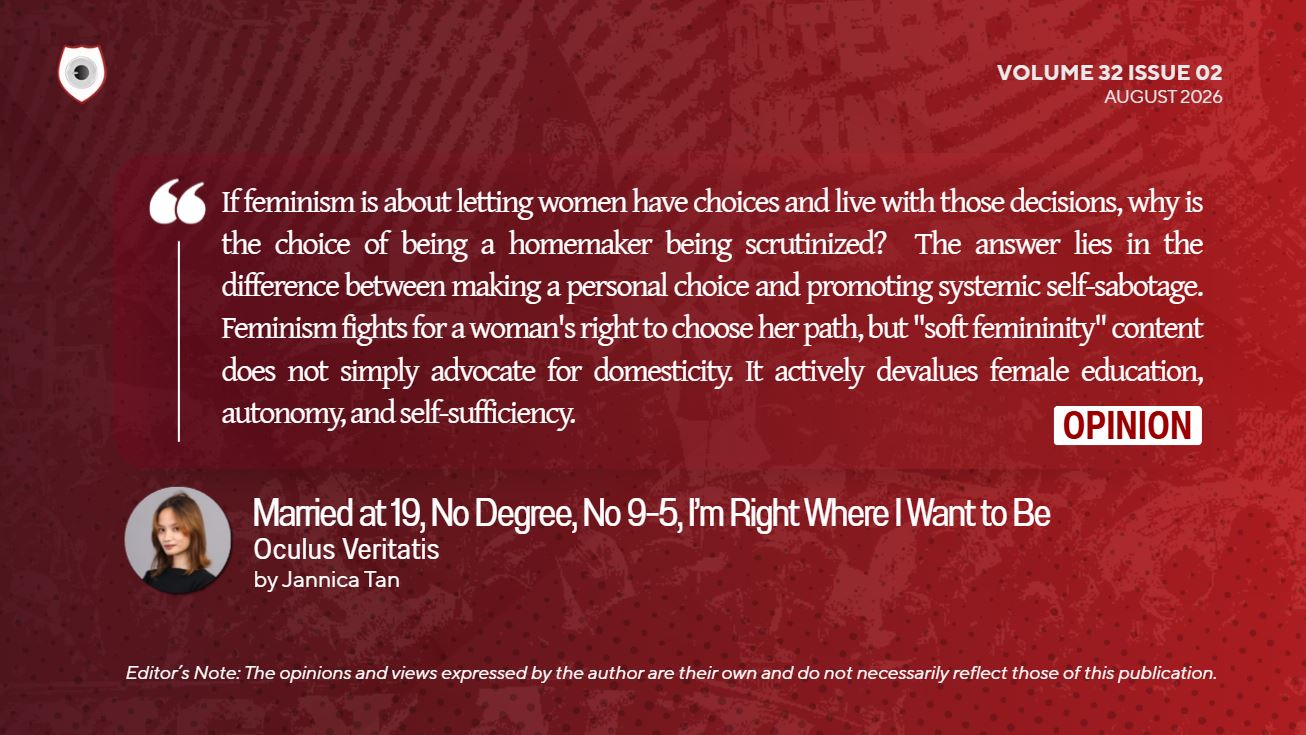
One of the most outrageous things I have seen was this: "Married at 19, No Degree, No 9-5, I’m right where I want to be." I’ve seen that it is a common pipeline among young influencers whose content features their daily lives as people who have passed up their chance to receive formal education in exchange for the comfort provided by their partner.
People might think it is ridiculous to feel so mad about something that seems trivial — after all, it is their lives and not mine.
Reality is that the internet is increasingly flooded with content about children raising children, captioned with things like: "Preparing my 2-year-old's dinner as a 19-year-old mom," or women glorifying the role of a "stay-at-home girlfriend"— an arrangement even more terrifying than being a stay-at-home wife.
Sometimes it isn’t marriage or children; sometimes it is simply about how to be a soft, gentle woman. It often involves letting a man take the lead so that he may fill his “true” masculinity, and a woman as a well-regulated partner who does not contest anything– and if she does, she must do it in a “feminine” way.
If feminism is about letting women have choices and live with those decisions, why is the choice of being a homemaker being scrutinized?
The answer lies in the difference between making a personal choice and promoting systemic self-sabotage. Feminism fights for a woman's right to choose her path, but "soft femininity" content does not simply advocate for domesticity. It actively devalues female education, autonomy, and self-sufficiency. Scrutinizing this trend is not about criticizing stay-at-home mothers; it is about exposing how these influencers paint extreme financial risk as an ideal lifestyle to young, impressionable audiences.
Choosing to be a homemaker with a safety net, higher education, and mutual respect is different from glorifying a nineteen-year-old having no degree, no job history, and total dependence on a partner.
Following the loss of autonomy is complacency. These young women are often told that older men know better, that they are the preferable option due to their economic stability and maturity. Under the romanticized guise of a “provider,” is a dynamic that frequently masks subtle forms of grooming and manipulation. People often counter with "not all men"—and while that may be true, this defense completely ignores the inherent danger of being groomed into economic overdependence. When a partner holds all the financial power, a woman is left with no safety net, no career foundation, and no leverage if the relationship turns hostile.
Even women who spend years working toward a degree still encounter difficulty securing employment—how much worse is it for a woman who has been subjected to financial dependence during the years meant for establishing her own stability and self-sufficiency?
The irony is that the women preaching about this lifestyle are not actually passive, dependent wives. They are influencers who earn through digital content-making and securing brand deals. They build their own independent wealth by selling a dangerous fantasy of dependence to young girls who will face real-world consequences without any of the influencer's financial fallback.
Misogyny has evolved and has softened in form, yet it remains to paralyze a woman’s independence.
What makes modern "soft femininity" dangerous is that men no longer have to enforce it—women are doing the work for them. Marriage and motherhood can be among the many things that make a woman’s life beautiful, but they should never come at the cost of her agency. With countless generations of women, including our mothers and grandmothers, spending decades dismantling the patriarchal system we still live in today, the rise of 'soft femininity' propaganda feels like an undoing of years of progress.
For years, we have been taught to believe that a woman’s femininity is merely a complementary feature to a man's strength—that women are never equals, only subordinates. A woman must be soft and submissive, serving merely as an instrument to unlock a man's full potential.
Once again, patriarchy wins—only this time, it is self-inflicted and rebranded as the ideal life.
Volume 32 | Issue 2