By Marie Leen Obal | November 9, 2026

By Marie Leen Obal | November 9, 2026
WHEN we were kids, we were taught a simple principle: whatever we borrow, we eventually return — gently and with gratitude. As we grew older, we learned that life expected the same of us: to return the people we love.
In his book, “Finding Chika,” best-selling author and journalist Mitch Albom reminded us of the profound value of time when he wrote, “The most precious thing you can give someone is your time, because you can never get it back. When you don't think about getting it back, you've given it in love.” We often fail to recognize how much love is woven into the time we give others until we no longer have the chance to give it.
We give our time in ways we do not always think of as acts of love. Sometimes, it means choosing to be with someone despite having only one free hour in a day, peeling shrimp for someone because we want them to enjoy their meal, and easing someone's mental load so they can breathe.
As the Sand Falls
Perhaps this is what makes time precious: we give it so freely to the people we love that we seldom pause to consider how little of it we possess. Like sand in an hourglass, it slips through the narrow passage between what was and what is, each grain falling into a past we can never return to. We assume there will always be more. More breakfasts to share, more days to come home to someone waiting by the door, more phone calls with a familiar, exasperated voice on the other end of the line, and more ordinary Tuesdays that seem too mundane to cherish.
A timer is loud: it announces the end. An hourglass is quiet. Its sand falls grain by grain, unnoticed and uninterrupted, never warning us until there is almost none left.
Grief reminds us how little control we have over the time we share with others. Losing someone we love makes us conscious of the hourglass. It makes us desperate to turn it over and begin again, but life offers no such mercy.
For those left behind, time continues all the same. The world keeps turning, the sun keeps shining, and the clock keeps ticking, even when we are not ready to keep up.
Shifting Motions
Still, we have little choice but to move with it. We wake up, put one foot in front of the other, carry the responsibilities that know nothing of time, and do it all again. We keep swimming, despite the depth of the waters, the strength of the current, and the waves that threaten to pull us under. Somehow, we find ways to stay afloat.
The waves are not the same every day. Sometimes, they’re gentle enough to let us catch our breath and swim a little farther, find our footing, and believe that perhaps the worst of the waves have passed. Then without warning, a song, an old photograph, or an ordinary moment we wish we could share pulls us beneath the surface again. We struggle for air, wondering whether we have made any progress at all.
Healing was never about learning to swim without ever being pulled under. It is about learning that being swept beneath the waves does not erase the distance we have already traveled. Grief like this only exists where love once lived deeply.
The Last Grain
In the popular television series “WandaVision,” Vision asks, “What is grief, if not love persevering?” The series follows Wanda as she navigates the grief of losing Vision, the man she loves, and confronts the reality of living without him. She creates a reality in which they can continue living together, albeit temporarily. Vision’s question captures the central tragedy of her grief: the pain of losing him is inseparable from the love she continues to carry.
Grief is the receipt that love once was here, proof that, at least once in our lifetime, we have experienced a love that endures beyond absence and transcends death, time, and even the universe.
Someone once told me that love is the root of all our emotions: the joy we feel, the sadness we carry, the anger we struggle to understand, the longing that lingers, and the pain and grief that follow loss. Perhaps grief reaches into the deepest parts of us because it grows from something we once held so dearly.
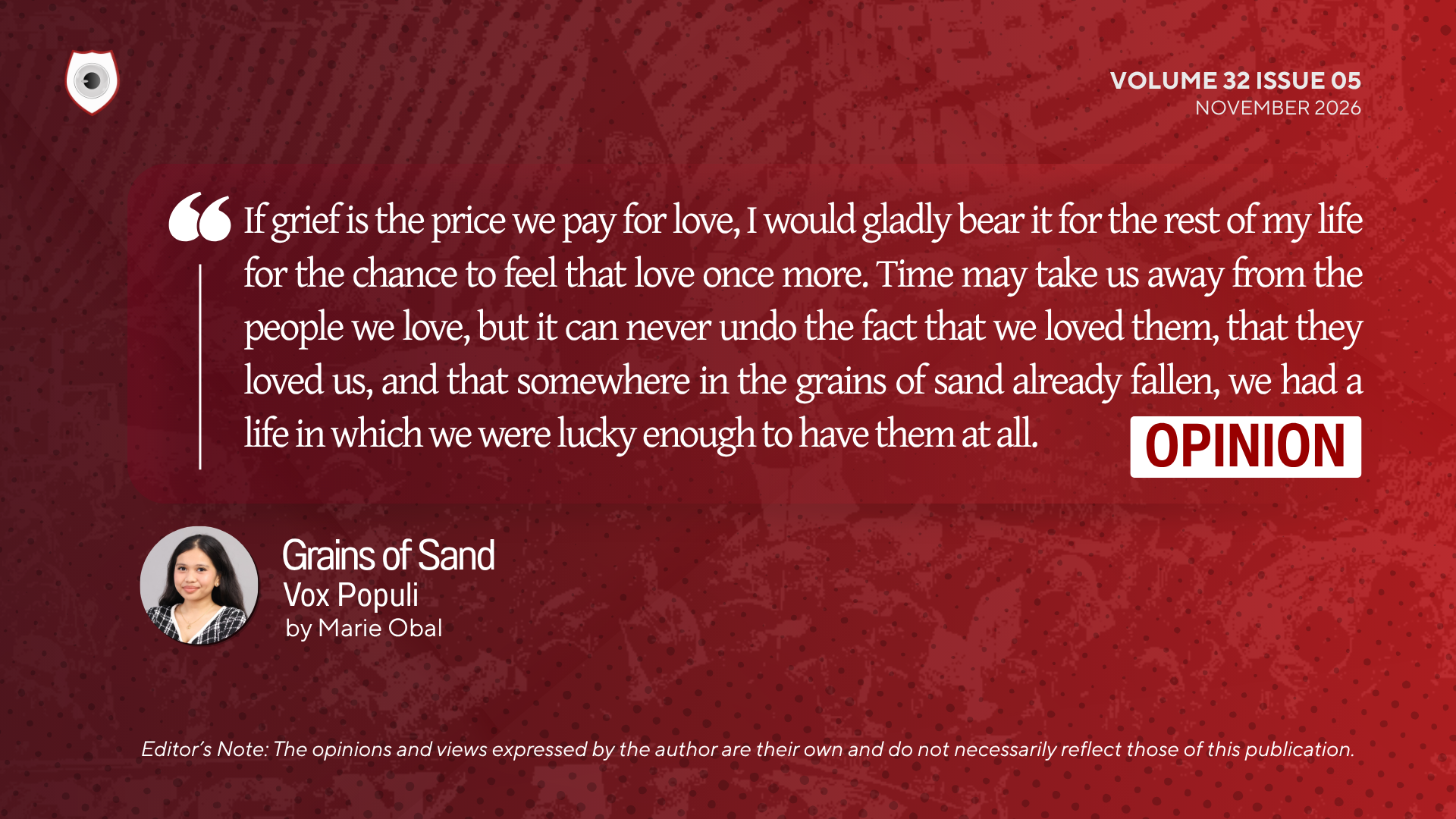
If grief is the price we pay for love, I would gladly bear it for the rest of my life for the chance to feel that love once more. Time may take us away from the people we love, but it can never undo the fact that we loved them, that they loved us, and that somewhere in the grains of sand already fallen, we had a life in which we were lucky enough to have them at all.
Volume 32 | Issue 5