By Marie Leen Obal |July 30, 2026

AI, Propaganda, and the Price of Truth
By Marie Leen Obal |July 30, 2026
WHAT separates journalism from propaganda? The question becomes harder to ignore when artificial intelligence allows media outlets to craft convincing narratives that blur the line between fact and fabrication.
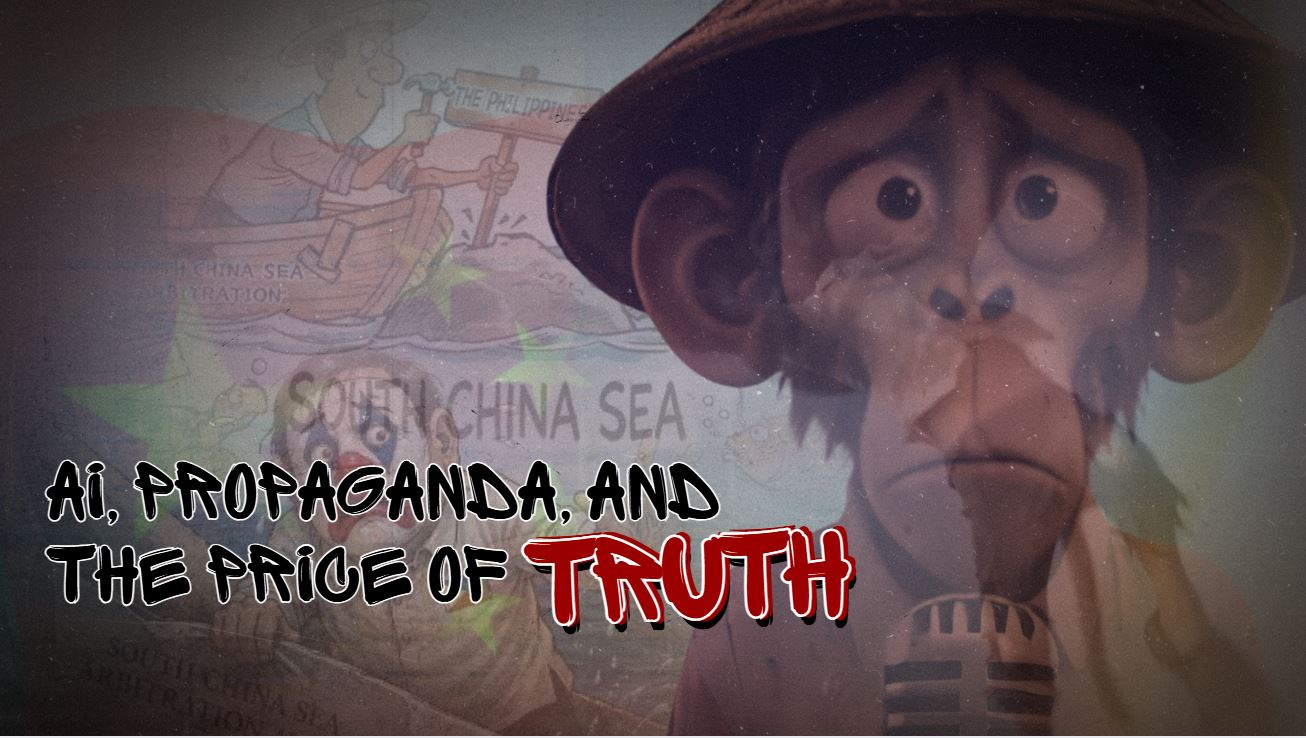
Last July 10, China Daily released an AI-generated video depicting a monkey dressed in a worn barong Tagalog and salakot being blasted by a water cannon. The video quickly drew attention for its portrayal of Chinese Navy vessels water-cannoning Filipino fishermen in the West Philippine Sea.
A Narrative of Its Own
The source behind the video is as significant as the message it conveys. Produced by China Daily, a state-run publication widely regarded as a mouthpiece of the Chinese government, the video reflects Beijing’s longstanding narrative on the West Philippine Sea dispute. Once again, it dismisses the 2016 Arbitral Award issued by the Permanent Court of Arbitration in The Hague, which invalidated China’s expansive “nine-dash line” claim and affirmed the Philippines’ maritime entitlements under the United Nations Convention on the Law of the Sea (UNCLOS).
Consistent with its long-held position, China continues to insist that the dispute be resolved through bilateral negotiations rather than international law. Such framing sidelines the Philippines’ legal victory and presents negotiations as the only reasonable solution, despite the tribunal’s ruling having already settled the legal issues surrounding maritime entitlements.
Beyond its political messaging, the video raised another, more troubling concern. On July 16, the Department of Foreign Affairs (DFA) condemned the video, arguing that AI-generated content using demeaning, dehumanizing, and racist depictions of Filipinos crosses a line that political debate cannot excuse. The video does not merely distort the facts of a maritime dispute—it reduces Filipino fishermen to caricatures, turning a geopolitical conflict into content designed to mock the people living through it.
The issue, then, extends beyond misinformation. It points to a growing unease over what AI now makes possible: not just faster falsehoods, but more convincing and more easily shareable contempt. The question the video raises is not only what it shows, but whose interests the story is built to serve. Cases like this force a larger question: where does information and influence begin?
The Line Between Truth and Influence
So what separates journalism from propaganda? Journalism serves the public, grounded in the pursuit of truth and the right to know. Propaganda, on the other hand, serves an agenda, shaping information to influence how people think, feel, and act. The China Daily video illustrates the distinction: a state-run outlet using AI not to inform, but to turn its rejection of a legal ruling into a diplomatic talking point—at the expense of the very people caught in the dispute.
Journalists cannot remain confined to audiences that already share the same beliefs. In an online environment shaped by algorithms and artificial intelligence, information increasingly travels within digital spaces where similar views are reinforced. Reaching beyond these echo chambers has become a challenge for journalism in addressing disinformation.
A journalist’s primary responsibility is to the public. As long as victims of injustice remain unheard, journalists must expose the truth and hold the powerful accountable. As campus journalists, we must continue to challenge distortions, pursue the truth, and refuse to grow weary of the work it demands. Those who seek the truth will find it—but only if journalists continue to make it visible.
Reading Between the Lines
Recognizing propaganda is only half the battle. The other half depends on whether the public has the tools to see through it. It starts with asking basic questions: Who made this, and why? A reverse image search, a check of the source’s track record, or a closer look at oddly stiff movements and inconsistent details in a video can reveal what a first glance misses. The China Daily video, for instance, carried telltale signs of being AI-generated once viewers looked closely, but its message had already spread before scrutiny caught up. That gap between exposure and verification is where propaganda does its damage.
Media literacy extends beyond identifying fabricated content. It requires examining who benefits from a narrative, what perspectives are omitted, and how selective facts shape public opinion. A viewer who asks only, “Is this real?” may still walk away persuaded by a narrative built on selective facts, even if the footage itself is genuine. The deeper skill is reading intent: noticing when negotiation is framed as reasonable in place of a settled legal ruling or when a caricature stands in for a person.
Campus journalists have a specific role to play here. Many young Filipinos get their news through social media, where AI-generated content can spread rapidly and be difficult to correct. In this environment, pausing before sharing and verifying before believing are as much a part of journalism as reporting itself. In a media landscape shaped by algorithms, media literacy is not a supplementary skill; it is the first line of defense. But even the most literate public is not immune to what propaganda, left unaddressed, can do over time.
If the belief that propaganda can demean Filipinos and weaken their resolve to defend what is rightfully theirs is allowed to take root, it does more than distort facts. It risks planting a diluted understanding of democracy in the public consciousness—one that perpetuates harmful ideas about what truth, justice, and democracy are meant to stand for.
In the end, the fight against propaganda is not only a fight over information. It is a fight over what people are made to believe, what they are taught to accept, and whether they will still recognize the truth when it is placed before them.