By Charlize Francheska Natan | October 3, 2026

By Charlize Francheska Natan | October 3, 2026
“Filipinos are resilient because we help each other, specially during disasters”
After every natural disaster, every typhoon, every viral photo carrying a child or even an elder through chest-deep floodwater, this line prevails as a compliment. It has been repeated so often that it no longer feels like an observation. It sounds like a fact, the same way we describe Filipinos as hospitable or say that the sun rises in the east.
Last August reminded us of the relentless monsoon rains and back-to-back tropical cyclones that battered Luzon and parts of the Visayas, killing at least 32 people, displacing communities, and causing billions of pesos in damage across the country, with several provinces placed under a state of calamity.
“Kakayanin natin ’to!” We tell it to our families and peers, in group chats and even through news reports. The phrase carries genuine comfort and pride in people who show up when no one else offers a helping hand. But we have repeated it for so long that harder questions begin to surface.
This is the question hidden underneath the compliments: Is resilience something to admire, or is it what remains when a system fails the very people it exists to protect?
Over the past years, flood-control spending has increased sharply, growing more than fourfold from around P81.2 billion in 2017 to P372.8 billion in 2025. Yet despite the increase in funding, flooding continues to displace communities and damage infrastructure. On paper, the increase should have translated into stronger flood protection. It has not.
The problem becomes clearer when looking at how flood-control funds were distributed over a recent three-year period. Roughly a fifth reportedly went to just 15 contractors. Meanwhile, some projects faced questions over unfinished or inadequate infrastructure, including riverbanks that were not reinforced and drainage systems that were marked “completed” despite reported deficiencies. The money did not simply disappear into an abstraction called “the system.” It went to specific contractors entrusted with projects meant to protect communities.
A budget that more than quadrupled in under a decade, concentrated in the hands of a small circle of contractors, and a monsoon season that still managed to displace millions and kill dozens—in the same country that told itself that the problem was being solved.
We need to make the distinction clear because we keep collapsing two different things into one word: resilience.
There is resilience as strength—the kind that shows up once, in an emergency, and deserves to be celebrated. Neighbors forming human chairs, fisherfolk turning their boats into rescue vessels, communities piling what little they have for people who have even less. This resilience is a virtue. It says something good about who we are to each other.
Then there is resilience as an adaptation to recurring neglect—the kind that isn’t chosen so much as conditioned into people who have learned, year after year, budget after budget, that no one is coming to fix the actual problem. This isn’t a virtue. It is a coping mechanism dressed up as a character trait, and the longer it goes uncorrected, the more it starts to look less like strength and more like an absence of any other option.
This brings us to the real hinge of the argument: When does resilience become an excuse for government failure? It would be unfair to strip communities of the credit for what they build together when institutions are slow or absent. These communal responses are real, and dismissing “Filipino resilience” outright risks dismissing something people have earned through real sacrifice.
Notice when that praise is most often spoken. It is rarely heard in budget hearings, planning sessions, or the quiet years between typhoons, when a unified flood-control plan could be drafted, funded, and completed. It arrives after the water has crested, after rescue operations have begun, after the damage has been tallied, and after the cameras are already rolling.
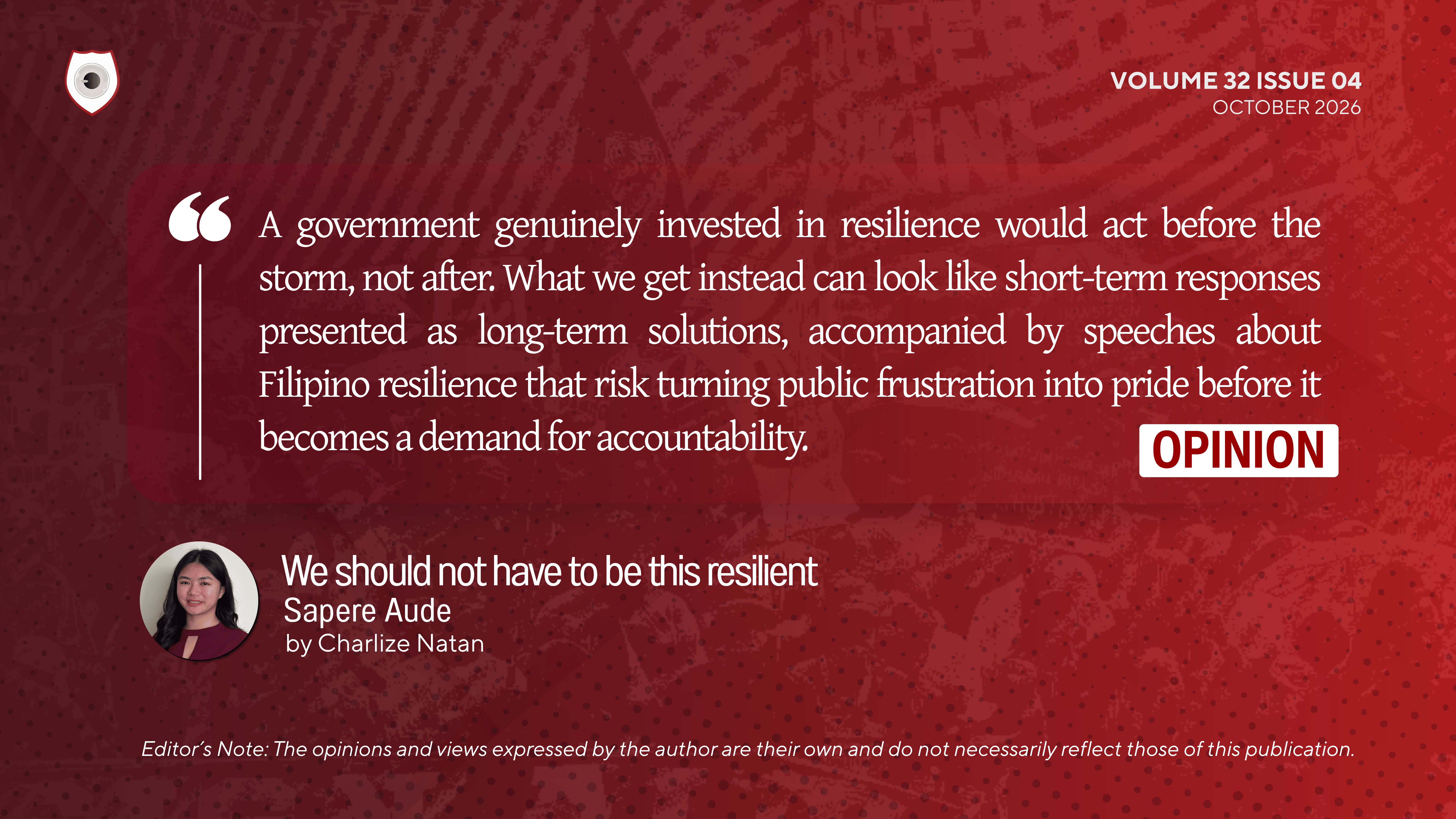
A government genuinely invested in resilience would act before the storm, not after. What we get instead can look like short-term responses presented as long-term solutions, accompanied by speeches about Filipino resilience that risk turning public frustration into pride before it becomes a demand for accountability.
But there’s a reason that the same phrase shows up so conveniently in government press releases after every disaster. When “resilient” becomes the state’s own talking point, praise quietly does the work that accountability was supposed to do. It reframes policy failure as a cultural strength to be admired instead of a systemic failure to be fixed. The government gets to call it heart. Communities are left to call it survival.
When survival becomes the expected outcome, disasters risk becoming something communities are simply expected to absorb again next year, with another budget increase, but without enough oversight or prevention.
We don’t deny that Filipinos are resilient. We know we are. We have loved through storms. Buried people we lost to floods that a functioning drainage system might have prevented, and still showed up for each other the next morning with some food to share. None of that needs proving.
What was always in question is what that resilience has been made to cover for. Admiration was never supposed to stand in for infrastructure. A grateful headline was never a substitute for the prevalent flooding, a drainage system that actually drains, a contractor that actually builds what the government already paid for. Bahala na, kakayanin natin ‘to are survival phrases, born from the absence of a plan, they were never meant to be mistaken for one.
Filipinos are not resilient because they help each other during disasters. Filipinos are resilient because they have to be—year after year, peso after peso, flood after flood—while the people responsible for making sure they wouldn’t have to keep calling it from a dry stage, stating admiration about who we are.
We are not asking anyone to stop helping our neighbors. We have never once needed to be told to do that. We are asking to stop having to—and to be met, for once, before the water rises, instead of being praised only for how well we’ve learned to swim once it already has.