By Haniel Mizukami | August 26, 2026

A New "Town" Is Coming
By Haniel Mizukami | August 26, 2026
“ATC or Town?” — a debate most Bedans have heard at least once. Some call it “ATC,” while others simply insist on “Town.” Whatever name we use, Alabang Town Center has become more than just a mall. For years, it has been the setting for after-class tambay, post-exam treats, quick meet-ups, and the little routines that made it feel like a second home.
Now, as the mall begins its redevelopment, the familiar Town that generations have grown accustomed to is preparing for a new chapter—one that may not only change its spaces, but also the memories attached to them.
Where It All Began
In the early 1970s, the Madrigal family entered negotiations with Ayala Corporation, then led by Enrique Zobel, over the development of a significant portion of Alabang. Rather than pursuing a straightforward sale, the two parties formed a partnership to transform the area into a master-planned residential and commercial district. The development would eventually include areas such as Madrigal Business Park and Ayala Alabang Village.
Alabang Town Center traces its beginnings to 1982, when it opened as Alabang Twin Cinemas with a supermarket and two cinemas. The development was also anchored by St. Jerome Emiliani and Sta. Susana Parish, a Roman Catholic church established in the 1970s.
The mall underwent expansions in 1994 and was relaunched as Alabang Town Center. It expanded once again in the 2000s and became part of the Ayala Malls portfolio in 2001.
A New Chapter in Town
Four decades later, the ownership of Alabang Town Center began to change. In late 2025, Ayala Land announced the sale of its 50-percent stake in Alabang Commercial Corporation (ACC), the company that operates the mall, to the Madrigal group for P13.5 billion. In a Philippine Stock Exchange filing, Lopez-led Rockwell Land Corporation also disclosed agreements to acquire shares from Francisco Madrigal Bayot Jr., representing the other owners of ACC.
Rockwell Land, the developer behind Rockwell Center Makati, entered the picture as a potential partner in the mall’s redevelopment. According to Rockwell Land Chairman and CEO Nestor Padilla, the opportunity arose when Bayot invited the company to explore redeveloping the property.
“This 17.5-hectare addition to our portfolio opens a meaningful opportunity to reimagine the lifestyle hub, preserving its charm and nostalgia while bringing in the distinctive Rockwell touch,” Padilla earlier said.
The company’s initial priority over the next two years includes enhancing the parking space, pedestrian flow, and retail mix. In addition, over the next five to 10 years, the company’s long-term vision is to restore the mall’s old charm while evolving it to a more vibrant lifestyle destination.
With the acquisition, Rockwell Land’s immediate priority is to ensure that ATC’s redevelopment proceeds smoothly. The deal is expected to add 137,000 square meters of leasable space to Rockwell Land’s portfolio, expanding its retail and office footprint by 58 percent.
“With greater ownership of the property, Rockwell Land is well positioned to advance its plans for Alabang Town Center while fortifying its portfolio of premium, integrated developments across the country,” Rockwell Land said.
More Than Just a Mall
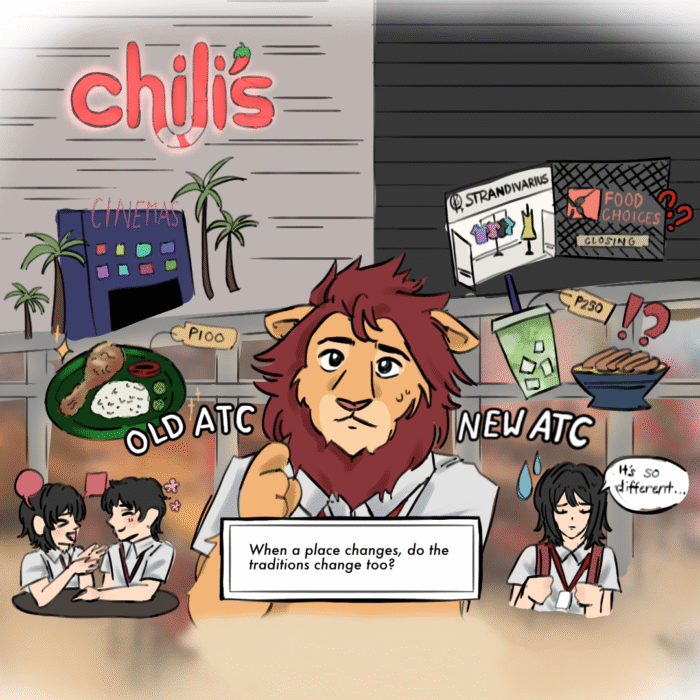
For Bedan students, going to ATC is practically a “piece of cake.” Just a short distance from SBCA, Alabang Town Center has long been part of the everyday Bedan experience. It is where students grab a quick meal during vacant periods, meet friends after class, or spend hours unwinding after a long day.
But now, that familiar place is changing.
As the redevelopment of ATC gets underway, several establishments have already closed their doors. Food chains such as Chili’s, 8Cuts Burger, and Popeyes, as well as stores like Nike, have temporarily ceased their operations. While some establishments are expected to relocate within the mall, others have yet to announce when they will return. Even Fully Booked, a familiar stop for book readers, is expected to close, leaving people to wonder which parts of ATC will still be there when the redevelopment is over.
Beyond the storefronts, the changes have also raised questions about workers and affordability. The closure of familiar establishments has left some visitors wondering whether ATC will retain the budget-friendly dining options that have long made it accessible to students and families.
For many, the concern is not simply about which restaurants will return, but whether the Town will remain a place where people can eat, celebrate, and spend time together without having to spend more.
Of course, redevelopment also means adapting to modernization and welcoming a new chapter for the mall. But progress does not always come without a sense of loss. For many, ATC is not just a collection of stores and restaurants; it is also where countless moments became core memories.
From grabbing Popeyes after class to celebrating a hard-earned victory over a meal at Chili’s, these places have quietly become part of the stories people carry with them.
Yet as some of these establishments close their doors, the “Town” that once held these everyday moments is slowly changing before our eyes.
For now, we may lose some of the places we knew by heart. Perhaps that is the bittersweet part of growing up: learning to let go of familiar places while carrying the memories they left behind.