By Alisandra Untalan | November 28, 2026

By Alisandra Untalan | November 28, 2026
IT starts in September. Parols hang from mall ceilings, plastic trees sparkle beside supermarket freezers, and a familiar playlist takes over the radio. Before the first cold front even arrives, the Philippines has declared the Christmas season open, and no one is allowed to argue. Somewhere in that playlist, between the jingles and the choirs, is "Pasko sa Pinas" by Yeng Constantino.
Don't get me wrong, it is a classic.
The melody is warm, the singing is lovely, and it captures what we love about our Christmas: the noise, the food, the relatives crammed into one house. But I have a strange relationship with one line in it, the one that says it doesn't matter if there's no money, as long as we're together, because Christmas in the Philippines is just different. For years I sang along without thinking.
And lately, it sticks in my throat.
The reason is the country that line is being sung in. We are living through a period in which corruption is no longer a rumor but a headline. Billions meant for flood control, roads, and public services have been traced to the pockets of people who now claim to be shocked by the mess. Meanwhile, ordinary Filipinos watch rice, vegetables, and electricity bills climb while their wages stay the same. When money is being stolen on this scale, "Di alintana kung walang pera basta't tayo'y magkakasama" stops sounding sweet. It starts sounding like something a thief would say.
That brings me to the psychology of music. Songs don't just reflect how we feel; they shape what we accept. A tune we hear every year from September to December, in malls, jeepneys, and kitchens, becomes background truth. We stop questioning the lyrics because we've known them since childhood.
So I wonder: does a song like this comfort people with low incomes, or does it quietly desensitize us? Is it sympathy, or is it a lullaby that teaches us to stop asking why we have so little?
Resilience is not resignation, yet Filipinos are often expected to be endlessly resilient rather than seeing systemic problems fixed. We laugh through typhoons; we share the little we have; we make a feast out of whatever is on the table. That is a strength, and it deserves respect. But resilience is what people show when they are forced to endure something. It was never meant to be a reason to let the problem continue. Praising our ability to be happy without money is a short step from saying we don't need the money at all.
It is also a convenient message for the wrong people. Imagine this jingle in the hands of a politician who has spent the year enriching himself. It could play at every campaign event and charity photo-op: look how simple and joyful the Filipino Christmas is, look how little we need. A song that makes poverty feel charming is the perfect soundtrack for those who benefit from it. I'm not saying the song was written for that purpose. I'm saying it can be used that way, and that it should bother us.
We have already seen the same spirit in how our officials talk. When a government suggests that a Noche Buena for a family can be put together for around 500 pesos. At the same time, prices of ham, spaghetti ingredients, and even a simple bottle of fruit cocktail keep climbing; that is the song's logic in policy form. Be grateful, be creative, be content. The burden of celebrating on a shrinking budget is handed to the household, not to the people who shaped the economy that shrank it.
So I have to ask: have we really come this far, to the point of making poverty look acceptable?
Christmas is supposed to be about generosity, about making sure that someone else's table isn't empty either. It is hard to find that spirit in a country where the people in charge tell the hungry to find joy in their hunger. A holiday of giving cannot be built on the idea that not having enough is part of the charm.
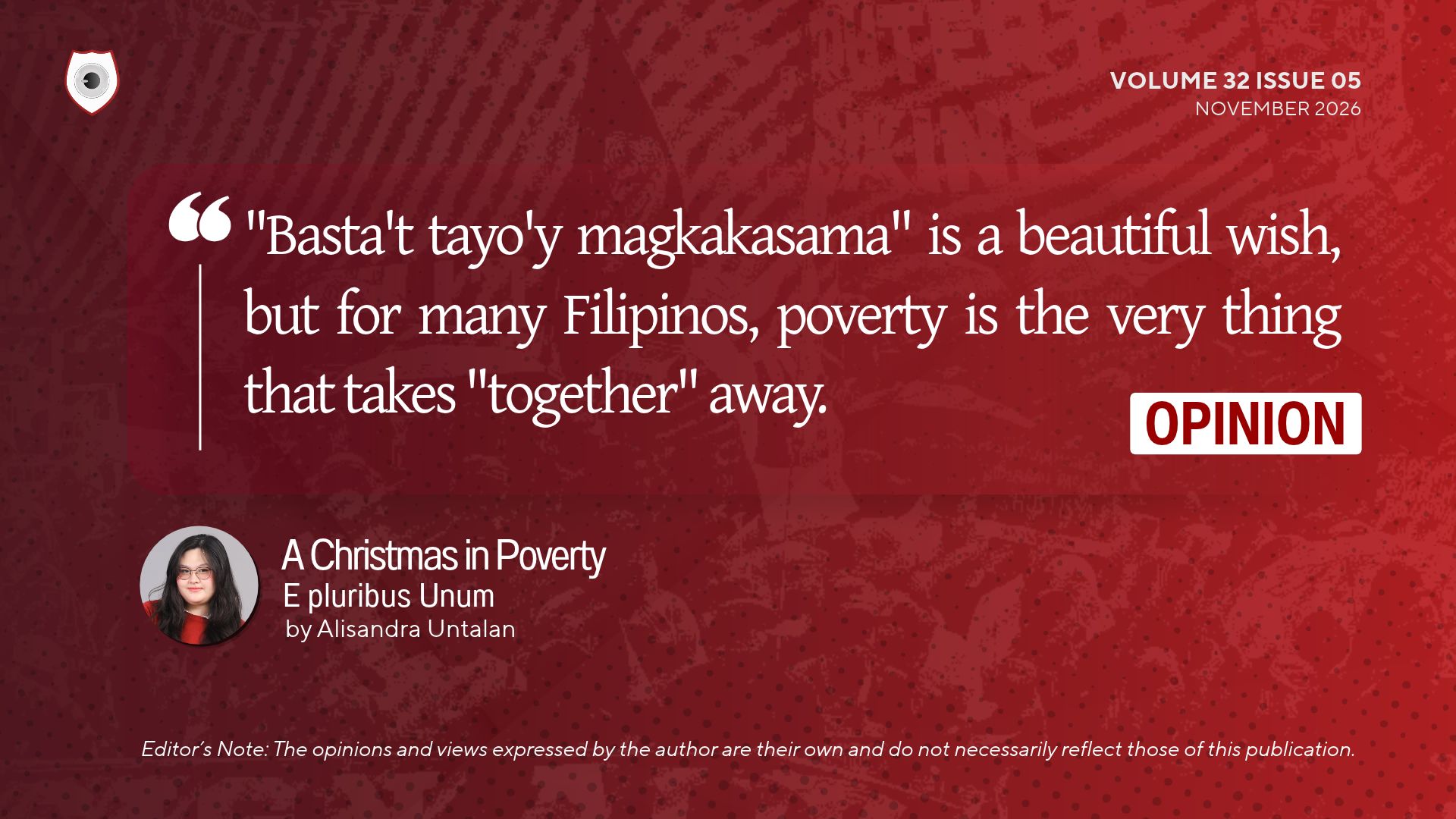
The truth is that togetherness is not guaranteed by love alone. Families are not always together at Christmas, and the reason is often money. Parents leave for jobs abroad and miss a decade of birthdays. Siblings split up to chase work in different cities. Children drop out of school to help earn. Some families are never together again because a sick relative couldn't afford treatment, or because hunger and desperation led to a tragedy. "Basta't tayo'y magkakasama" is a beautiful wish, but for many Filipinos, poverty is the very thing that takes "together" away.
Every time I hear the song now, and I seem to hear it more often since I noticed how I felt about it, I'm reminded of that gap between the lyrics and reality.
I hope Filipinos don't take its message literally. I hope we don't come to believe that happiness without money is the natural order, or that being with family substitutes for food, medicine, and security. Love is what we give each other. Dignity is what we are owed.
A song like this shouldn't have to exist.
In a country where work paid enough, where public funds reached the people they were meant for, and where no one had to calculate the cost of a Christmas ham against a week of rice, no one would need to be told that money doesn't matter. We would simply have enough.
Until then, I'll still listen to the song, because it's part of our December. But I'll listen knowing that our task is not to make peace with poverty, but to hold our government accountable, so that Filipinos can be happy because they are secure, not in spite of being poor.