Written by Isabel Daenah Y. Manzanero | July 5, 2026

Written by Isabel Daenah Y. Manzanero | July 5, 2026
“MAHAL ang magmahal,” is a common notion passed around on social media these days. It reminds the viewers of the value of love, what it asks of a person, what is expected of them, and what it takes to be committed. Truly, loving is expensive. It is mentally, physically, emotionally, and financially taxing. And this same idea is echoed in loving the Philippines – ang ating perlas ng silanganan – it requires and asks a lot from everyone who tries.
Almost every month, Philippine politics hits its people through every angle by every known weapon at their expense, leaving bloodshed in its wake.
Only in July 2025, the probe into flood-control projects was commenced upon the report of irregularities and inconsistencies. Various members of the government, most of whom are senators and congressmen, were tied to suspected contractors for corruption. Last August 2025, the impeachment case against Vice President Sara Duterte on grounds of alleged misuse of confidential funds, unexplained wealth, and alleged assassination plot against President Ferdinand Marcos Jr, was archived. But upon the senatorial leadership shakeup recently, the impeachment trial against Duterte shall proceed on Monday, July 6, 2026. Then, last May 2026, the Congress’s frequent absentee Senator Ronald “Bato” Dela Rosa appeared in public after six months, which had 58 session days, and stated to have done so to change the Senate leadership as the 13th vote.
And this is only the tip of the iceberg.
With all of these plaguing the state of our nation, most people would choose to leave the country and start a new life elsewhere. The statement is shared through casual conversations, shared posts on social media that gain traction, and even in serious exchanges when asked about plans after graduation. All with the underlying idea of “wala nang pag-asa ang Pilipinas.”
As reported in Think Tank OCTA Research’s Q1 Tugon ng Masa survey on June 15, 2026, 57 percent of Filipinos would prefer to live or work abroad if the opportunity is provided. The data also shows that willingness to migrate appeared highest among those aged 18 to 24 years old, with 81 percent, and 25 to 34 years old, with 75 percent.
To love the Philippines is an expensive feat beyond compare, because to love the country is to continuously fight for it, and to fight for it is to remain within its bounds to protect it, and to stay is to decline those chances towards greater prosperity.
It is not to say that leaving and starting a new life is a horrible thing; it opens a person to countless opportunities, “a greener pasture,” and a brighter scene for the future to come. But the patriotic side of me would always argue that, as our national hero, Dr. Jose Rizal, would like to refer to the youth as the hope of the nation, we, as fresh graduates, are the highest hope the country could offer. Not only in the workplace, but in society as a whole. Hope for voters who have standards, hope for people who are aware of what is happening in the world, and could use that to educate countless others, and hope for a brighter nation.
The argument continues to circle politics, but it remains the center of our being.
It is also not to argue that those who choose to leave love the country any less. But rather, this is a love letter to my fellow countrymen to not lose hope in the Philippines. For the moment, we lose hope is when we start to fall into a pit of despair and allow fear to encapsulate us. If we, the people of the country itself, lose hope, then where will we derive the strength to fight for it? To fight for what is right, just, and proper for every single person through every means possible.
“Ang hirap mong mahalin, Pilipinas,” is another common phrase that is often accompanied by infographics depicting the current political landscape of the country. And yes, there is no denying that the Philippines is hard to love, and even more so when you are thrust with factual information of all the reasons why it is difficult. Love is easier to let go of when the stakes get hard, when everything around you screams at you to release yourself from the heartache and pain.
But if we give up now, lose hope in the country and its people, and ultimately lose the love we have left for the Philippines, then what would this cost us? What would this cost future generations, both those born and unborn?
Are we going to allow ourselves to wait around and find out, or will we ourselves rekindle the hope and love towards the country? To love the Philippines is a taxing thing that takes a toll on those who desperately want to, but that’s also the beauty in it; you see the cracks beyond the surface. To see beyond face value is a testament to feeling a little deeper and loving a lot fiercer.
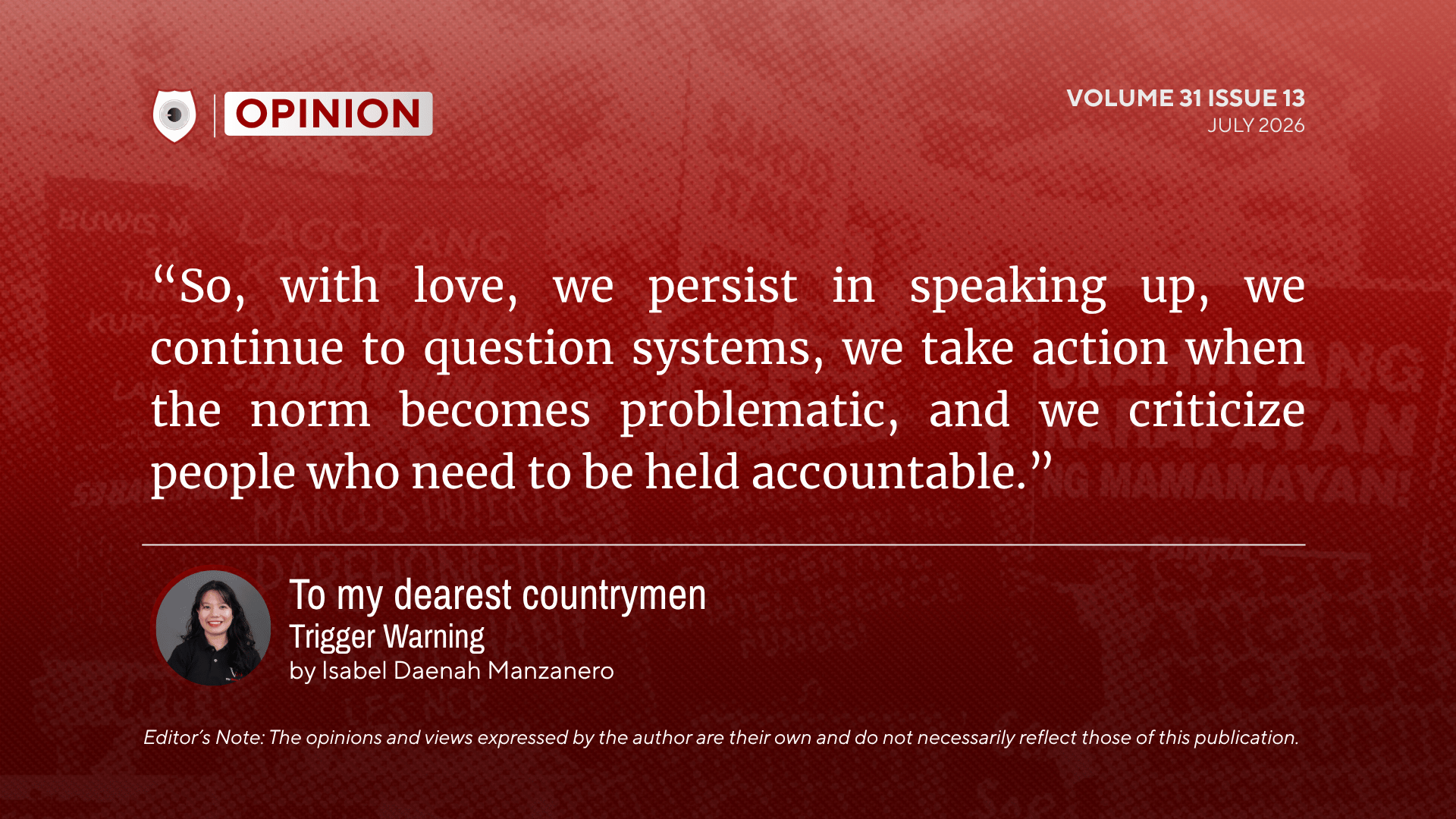
So, with love, we persist in speaking up, we continue to question systems, we take action when the norm becomes problematic, and we criticize people who need to be held accountable.
Like every other love we experience in the span of our lives, I hope that we remind ourselves that to love the Philippines is to the extent of and as worthy as loving another. It will always be worth fighting for with blood, sweat, and tears, worth the emotional, physical, and mental expense, and worth the wait for it to rise beyond the ashes from the hope of its people.
The Philippines cannot lose its countrymen. The Philippines needs you and me. So, as our final act of love, we fight, we stay, and we hope.
Volume 31 | Issue 12