TO me, freedom means doors — a lot of doors. Too much, in fact, that we drown in all these open possibilities that promise us fulfilling lives, so long as we choose the “right” one. Endless choices, endless paths, and endless versions of ourselves living seemingly different lives. And yet, these innumerable doors leave us with no sense of purpose; where every step feels like a loss, and this so-called freedom instead becomes a slow death of indecision.
“You can be everything you want to be” are words we usually hear in our formative years, encouraging us to reach beyond the stars and to imagine ourselves in a light that we deem as successful.
We wear costumes of our dream professions, viewing those professionals as heroes we aspire to be. At these tender ages, we believe that there’s only a singular path to life — and if we fail to become our ideal selves, we believe that we’ve failed life itself.
The more we age, the more we realize that there isn’t a set path designated for us, but a series of doors should we choose one to step into.
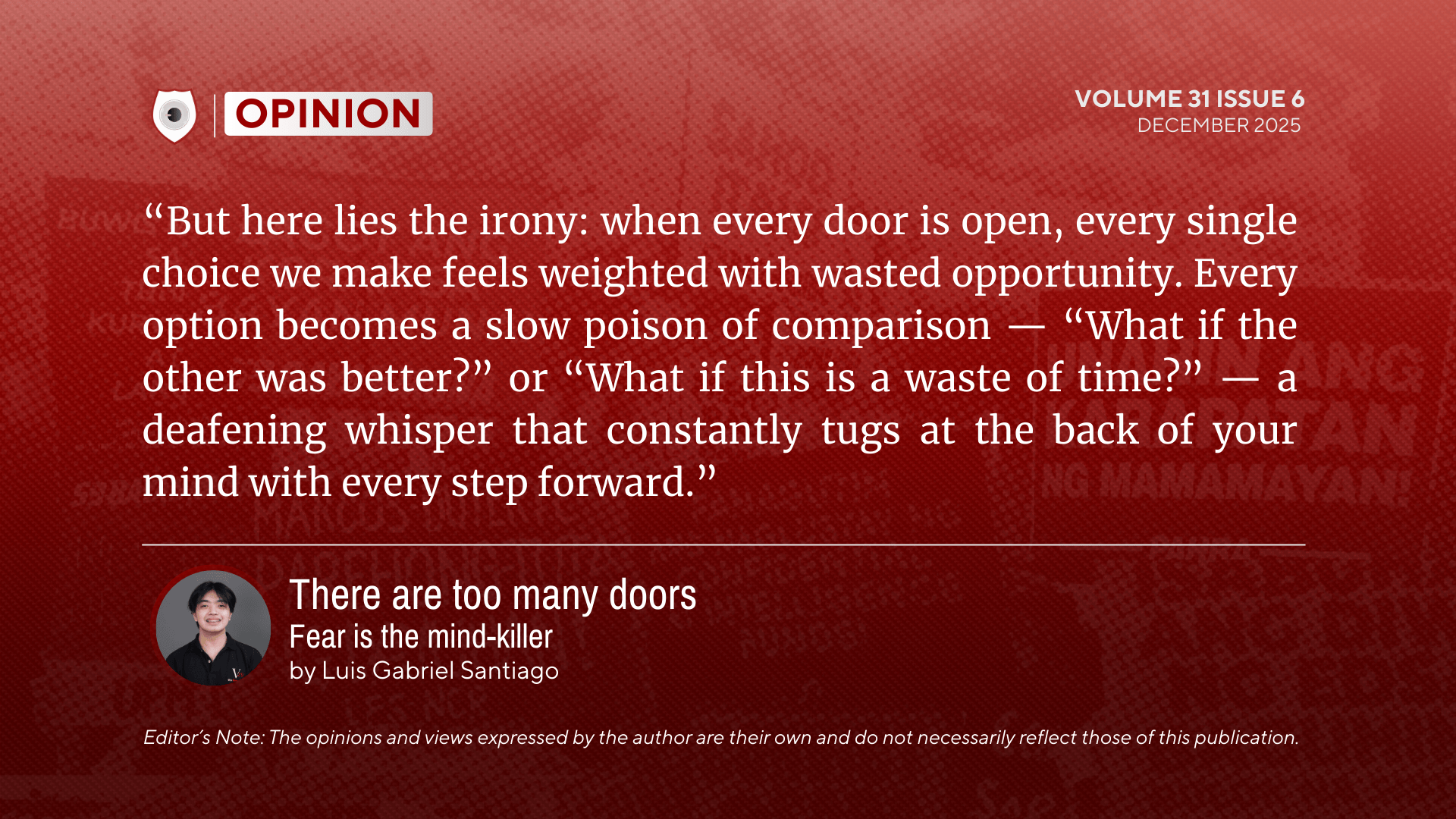
But here lies the irony: when every door is open, every single choice we make feels weighted with wasted opportunity. Every option becomes a slow poison of comparison — “What if the other was better?” or “What if this is a waste of time?” — a deafening whisper that constantly tugs at the back of your mind with every step forward.
Or is it forward? Now we’ve conditioned ourselves to second-guess if even choosing something is a step in the right direction or one that regresses back.
More options don’t liberate us; they paralyze us. We don’t simply choose anymore; we negotiate with potential, with fear, with the haunting idea that the life we commit to may not measure up to the sum of all the lives we could have lived.
American Psychologist Barry Schwartz calls this the “Paradox of Choice”. His book explores that while we often assume that more choice equals more freedom, in reality, too many options in everything from consumer goods to life decisions lead to indecision, regret, and dissatisfaction.
Now, every door we look past is a reminder of something that we have to leave behind. It almost feels like a betrayal to some version of ourselves we hoped, even for just a moment, to become.
And so, we hesitate, we keep our doors open; not because we “feel” that there might be greener pastures presented to us, but rather because we are terrified of becoming a different version of ourselves — in our eyes, “wrong” even.
It is fear that glues this machination running: the fear of missing out. The fear of being left behind. The fear of ending up in a life ultimately “smaller” than what we envisioned ourselves to be.
A life spent perpetually weighing options is a life slowly consumed by indecision, and with no closed doors, is there even a clear path to take? We delay not only our options but life itself.
In a world of excess and easy access, the best option may be to choose whatever, really, to trust that whatever decision, even an “unoptimal” one, is better than a life spent waiting for the impossibility of certainty.
With how much there is out there, maybe true freedom comes not from keeping all doors open but from choosing one, stepping right through it, and embracing the uncertainties that come along with it. Learning to accept loss, in closing doors that will never open to us again, now that is a step in the right direction.
To hell with all that unmet potential.
Only in the act of committing to something can we reclaim agency of our lives, reclaim our direction, and turn the possibilities given to us into life.
Because in the end, the tragedy of endless options is not that life gives us too little — it is that it gives us too much. And only by choosing, imperfectly and bravely, can we transform the paralysis of possibility into our purpose.
We shouldn’t be perpetually stagnant in that endless hallway, let’s begin by putting one foot in front of the other.
So, choose.