By Alisandra Sophia M. Untalan | January 28, 2026

By Alisandra Sophia M. Untalan | January 28, 2026
IN celebration of the 70th anniversary of the Rizal Law, also known as Republic Act No. 1425, the Rizal Development and Heritage Center Foundation held "Padayon sa Pagbabago," a three-day forum anchored on the theme “Transforming systems in the Philippines through education,” from Jan. 22 to 24, 2026, at the Asian Institute of Management conference center in Makati City. The event was organized in partnership with The Rizal Academy for Innovation and Leadership (TRAIL) and the U-School.
Day 1: The Rebirth of the Republic
Opening the conference, retired Ombudsman and former Associate Justice Conchita Carpio-Morales emphasized the importance of restoring public trust in governance, noting that corruption persists not due to weak laws but weakened moral resolve.
She asked, "Despite our inspired Constitutional and legal rules, why are we in such a mess?" citing the erosion of civic vigilance and moral compass as root causes of systemic corruption.
Following the keynote address, the first panel discussion—featuring former Senator Jose D. Lina Jr. and Con-Con delegate Rodolfo D. Robles—examined the Constitution’s responsibility not only to protect and preserve, but also to “perpetuate beyond generations."
During the discussion, Lina emphasized that leadership is inseparable from moral formation, stating: "The bedrock of leadership is morality—and the spirit of love of God and love of Country."
Echoing the need for ethical governance, Robles stressed accountability as essential to law and order, stating, “To make our country great again, we should not let small crimes go unpunished.”
Shifting to a systems-thinking perspective, Ms. Maria Belinda L. Villavicencio, a faculty member of TRAIL, introduced an Awareness-Based Systems Change Methodology and the Iceberg template to analyze corruption through events, patterns, structures, and mental models. Through this approach, participants were encouraged to look beyond surface-level problems and consider the deeper systemic factors that sustain corruption.
Expanding on structural reform, Dr. Maria Cielo D. Magno—economics professor of the University of the Philippines—stressed that legal Prosecution alone is insufficient, stating, "Prosecution and conviction are not enough to prevent repetition. There must be a change not only in structures, but in relationships."
Con-Con delegate Lilia B. de Lima, on the other hand, identified political dynasties as a central driver of systemic corruption, going so far as to describe the Anti-Political Dynasty Bill as a Pro-Political Dynasty bill, given its minimal prohibition against political dynasties.
During the following panel discussion, Con-Con delegate Amado S. Tolentino Jr., Dr. Emmanuel F. Calairo, and Dr. Joseph C. Renta III emphasized that constitutional development must be grounded in Filipino identity and indigenous values.
Dr. Renta highlighted the Filipino Psychology of "Kapwa," noting that corrupt officials are not part of Filipino culture, "Filipino indigenous people have a responsibility to the divine. These spiritual values do not match those of the corrupt officials," he said.
Tolentino Jr. stressed that all issues concerning education must be addressed, while Dr. Calairo added that symbols and stories often shape Filipino nationhood, and that our history must be understood most through lived experience and meaning.
Day 2: The Hero’s Journey
Senator Paolo Benigno “Bam” Aquino IV discussed the state of Philippine education, his anti-corruption reforms, and key points from the 2025 campaign. “This is a period in our history that we are in the middle of an education crisis,” he said, emphasizing the need for stamina and endurance in addressing the said reforms, announcing the launch of the 10-Year Education Reform Plan that week.
On addressing corruption, Aquino stressed the need and importance of a systems-based approach, stating that solutions must go beyond single perspectives and instead address larger, interconnected systems. Reflecting on the 2025 campaign, the senator shared the importance of youth support for both himself and then–vice presidential candidate Sen. Francis “Kiko” Pangilinan.
“Our electorate is getting younger. Malaki ang tiwala ko sa kabataan—but only if we invest in education that prepares them not just to work, but to serve,” he added.
Con-Con Del. Pablo S. Trillana III offered a new perspective on the familiar metaphor of Artificial Intelligence as an “elephant in the room,” and instead, replaced it with a bulldozer. “Make sure that this bulldozer creates good infrastructure instead of destroying the entire room,” he said.
Meanwhile, Fr. Tito D. Soquino, OSA, reflected on the economics of AI, stating, “AI is merely a tool, but the tool that drives AI is economics, capitalism, and profits.” He shared that the system is a paradox that companies tap into to write code, and that eventually society will be coded into the system.
Imago Dei: The Man behind the Bulldozer
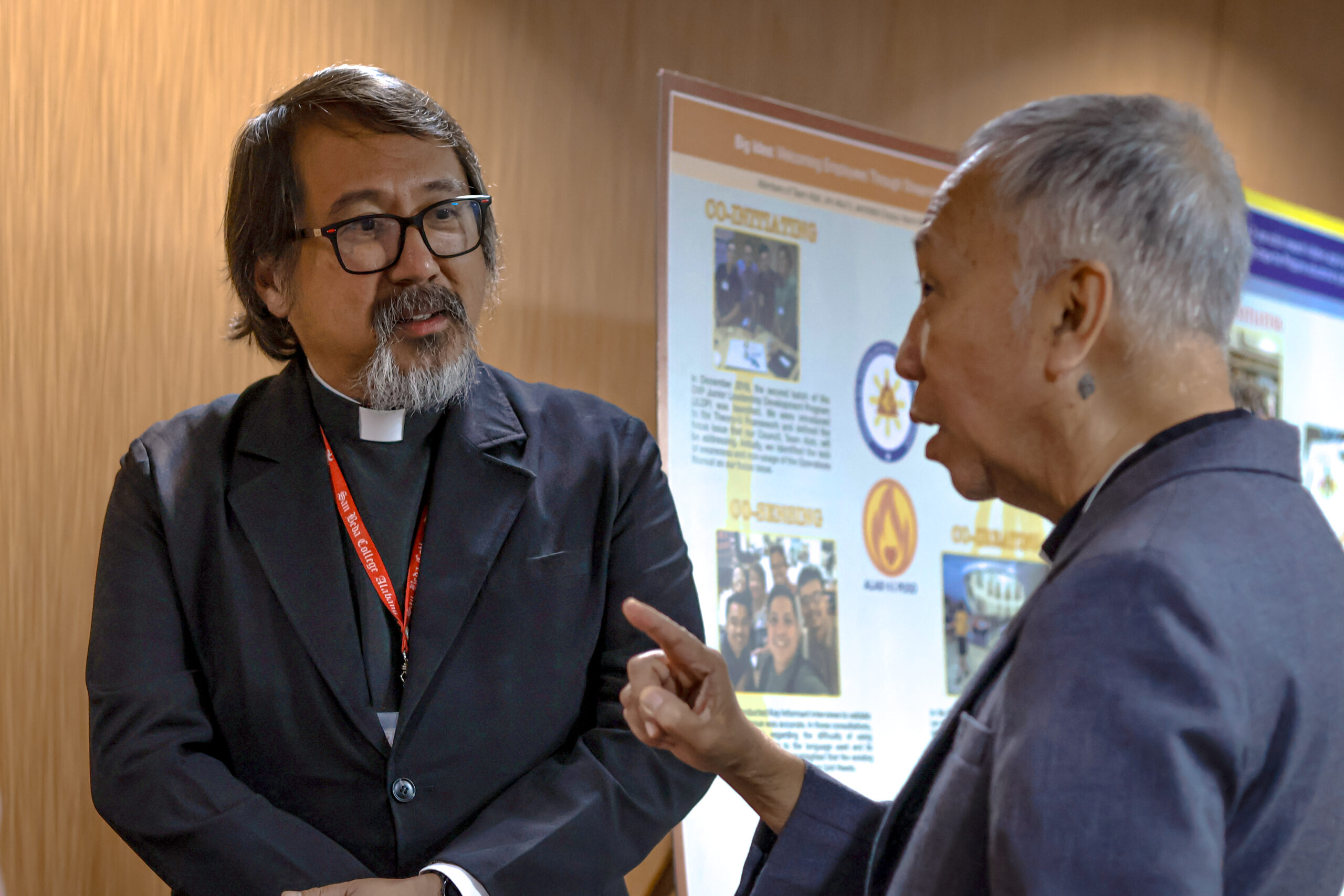
During his panel discussion, Fr. Gerard Ma D. De Villa, OSB, emphasized the idea of forming a conscience that reflects on the Filipino value of “Kalooban,” which relates to God’s will, or “Kalooban ng Diyos,” stating that our conscience should be a formed conscience, especially when driving the “bulldozer.”
“The Catholic Religion teaches us that family ought to be teaching good consciences for the future,” he stated, noting the importance of family in guiding the youth. He added that God is a simple being, and that humanity’s goal should be to reflect this simplicity in striving toward Imago Dei.
The Future of TRAIL and SBCA
In an interview with THE BEDAN HERALD, Ms. Marisol "Besol" D. Lopez, founding chairman of the Rizal Academy of Innovation and Leadership, explained that “Padayon sa Pagbabago” served as both a commemoration of the Rizal law and a platform to reexamine how Rizal should be taught beyond secondary and tertiary education.
She also introduced the Emerging Leaders Innovate Across Sectors (ELIAS) Program, which invites Rizal educators to prototype a curriculum on Jose Rizal spanning grade school, high school, and college levels. The program will undergo a seven-month pilot at the College, with its outcomes documented and shared for collaboration with other schools following a successful launch.
As Padayon sa Pagbabago came to a close, Lopez reflected on the eye-opening panel discussions throughout the three-day forum:
“I saw the light amidst the dark, I got to witness good Filipino leaders, and at the same time the youth! As Rizal said, ‘ang Kabataan ang Pag-asa ng bayan’, and it’s only with Education that we can bring out their brilliance,” she said.
Echoing this sentiment, Jose Mari Bautista (IV-BSLM), chairperson of the Bedan Electoral Committee, emphasized that corruption will never end if those who are entrusted with the constitutional right to vote fail to recognize the weight and responsibility that comes with it.
“Real change starts when the youth become vigilant, principled, and brave enough to choose leaders wisely. Only then can we break the cycle of corruption and move toward genuine national progress,” he said.