By Darryl Mattheo P. Golla & John Marion De Guzman | October 23, 2026

By Darryl Mattheo P. Golla & John Marion De Guzman | October 23, 2026
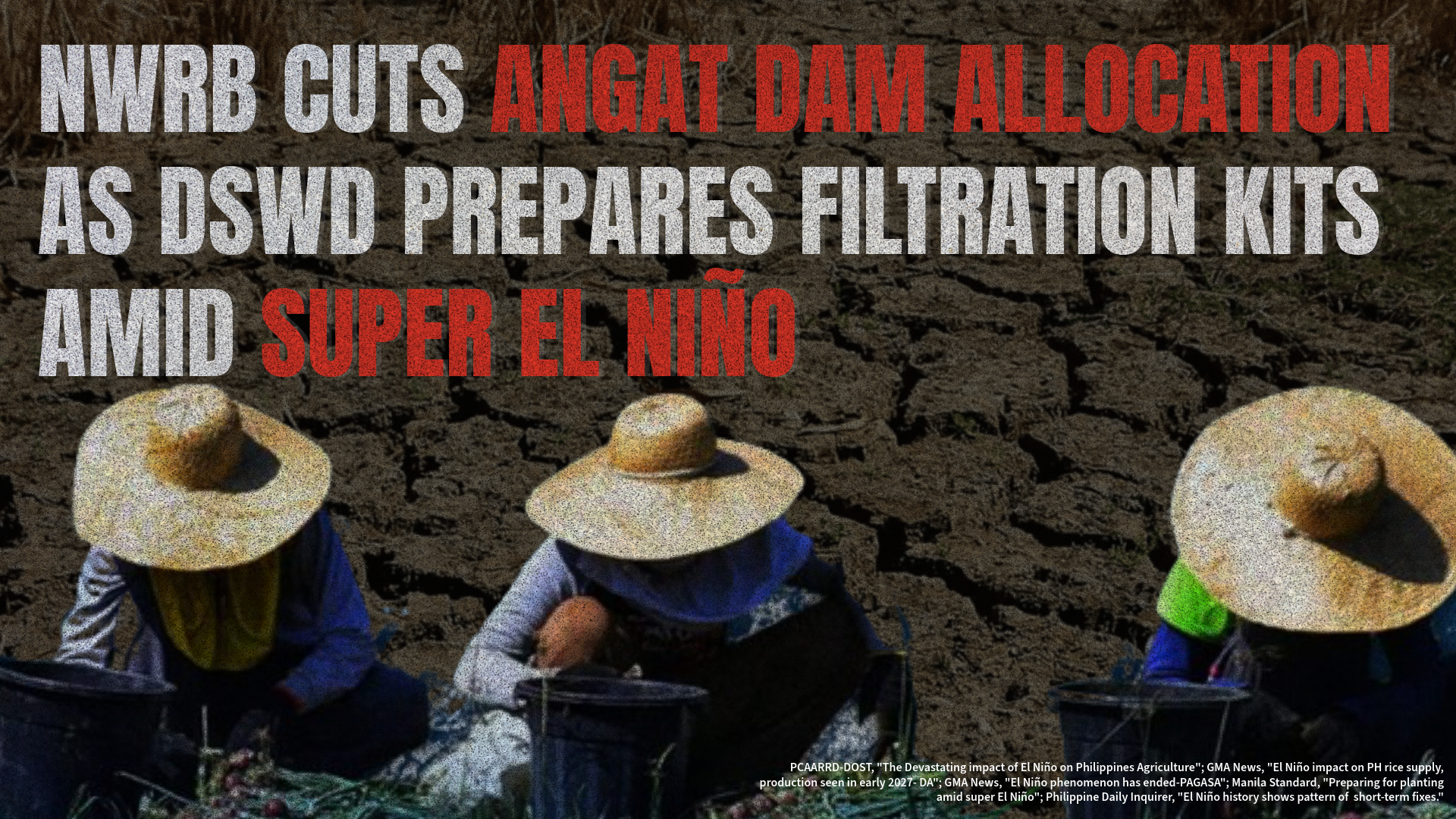
TAKING precautionary measures against Super El Niño projected to last until 2027, the National Water Resources Board (NWRB) has imposed reductions in water supply from Angat Dam, located in Bulacan, for water consumption needs within Metro Manila, as well as irrigation facilities in Pampanga and Bulacan.
Government Urges Water Conservation
Seviolio David Jr., NWRB chief, said that the agency scaled back the water allocations in the National Capital Region from its normal 50–52 cubic meters per second to 44–46 cubic meters per second. “For the month of October, nagkaroon po ng adjustment. Meaning, binabaan po muna natin ‘yung requirement of water supply for Metro Manila. Kasama po dito ‘yung mga households and industries. Pero hindi po ibig sabihin nito na mababawasan ‘yung supply po sa mga kabahayan.”
David further added that the allocated water supply for Metro Manila is sufficient and will last until the end of 2026 or early 2027. Water concessionaires may also source water from Laguna Lake and deep wells to supplement the reduced allocation.
The adjustments aim to conserve water stored in Angat Dam, supplies around 90 to 98 percent of Metro Manila’s water needs and supports irrigation in nearby agricultural areas, ahead of the dry season and the expected peak of El Niño, which could reduce rainfall and affect water availability in the coming months.
The Philippine Atmospheric, Geophysical and Astronomical Services Administration (PAGASA), warned that El Niño could intensify before the end of 2026. Its effects may continue through the first half of 2027, increasing the likelihood of below-normal rainfall, dry spells, and droughts in parts of the country.
NWRB is strengthening its water conservation campaign through rainwater harvesting, water recycling, leak repairs, and reduced non-essential water use, instead of imposing new restrictions. It is also reinforcing an existing order requiring government offices to cut water consumption by 10 percent.
David added that restaurants may be encouraged to provide water to customers only when requested. “Kung iinom ‘yung tao, doon lang po natin sila bibigyan,” he said.
Meanwhile, the Department of Environment and Natural Resources (DENR) is developing a policy to regulate water use and introduce restrictions if needed. He said that the NWRB is seeking additional funding for 2027 to strengthen water conservation campaigns, monitor water supplies, identify potential sources, and assess areas outside Metro Manila experiencing water stress.
The agency plans to assess the Mindanao River Basin, parts of Negros Island, and selected cities and municipalities to determine groundwater availability and identify possible additional water sources.
“Likewise, sabi natin ‘yung mga regulation and monitoring natin for next year po ay gusto nating i-focus ‘yan dun sa mga areas that may be affected by this El Niño phenomenon. Likewise, isa sa mga ginagawa din po ng NWRB for next year ay ‘yung mga assessment po ng mga water stress areas outside of Metro Manila,” David said.
He shared that the agency’s proposed budget for 2027 consists of P284.35 million, provided that NWRB will focus on monitoring and regulating areas that may be affected by the super El Niño for the following year.
Marcos Urges Rainwater Collection
On October 11, President Ferdinand “Bongbong” Marcos Jr. urged the public to prepare buckets and containers for rainwater collection as the government plans to launch an information campaign on proper rainwater collection, filtration, and treatment to ensure safe use.
“Bumili na kayo ng balde para kapag umulan, makolekta na ninyo lahat. Tuturuan namin kayo…we’ll give you the filter. We’ll teach you how to do everything para hindi kayo magkasakit at maayos ang pag-treat ng tubig,” he said.
The statement of the president since then has gained public criticism, providing that it was a joke. The August Twenty-One Movement (Atom) criticized the president’s suggestion, calling it inadequate amid rising prices, fuel costs, and alleged anomalies in flood control projects. "Mukhang gusto niyang gumastos tayo para sa... balde. Para mag-ipon ng tubig-ulan, upang maging breeding ground ng mga lamok at mapagkukunan ng dengue at iba pang sakit," the group said.
On Oct. 13, during a press briefing, Palace Press Officer Claire Castro addressed and defended the statement of the president, providing that it was not a laughing matter as the adverse effects of El Niño may worsen in the following months. “Sineseryoso ng pangulo ang magaganap at nagaganap na at maaaring mag-worsen sa mga susunod na buwan. Ang bawat pagtalakay dito, ang bawat mensahe, ang bawat suggestion, ang bawat mga binibigay na aral sa atin ng gobyerno at ng pangulo, ito ay dapat na sineseryoso,” Castro said.
Castro then confirmed that the buckets would be used for rainwater collection as part of the methods the government, particularly the Department of Social Welfare and Development (DSWD), plans to teach the public.
Demonstration of water filter kits
The following day, DSWD Secretary Rex Gatchalian, along with Palace Secretary Castro, demonstrated how to install a water filtration system, showing a 20-liter bucket containing water with soil. Gatchalian and Castro then drank the filtered water, attesting to the water quality. “The water is clean,” Castro said.
Gatchalian said that the water filtration kit may filter water from springs, deep wells, and even collected rainwater. The kit can filter as much as 1 million gallons over five years, with a bacteria and pathogen removal rate of 99.99 percent—stating that the agency considers it a “medical device”.
"In fact, noong 2025, noong nag-automate tayo ng ating Luzon Disaster Risk Resource Center, iyong pangulo natin mismo dinemo niya ito," Gatchalian said, citing the use of filtration kits in Batanes during Typhoon Julian in 2024, when the storm affected sources of portable water. The agency also deployed the equipment in Davao Oriental in 2025. Gatchalian said the DSWD had stocks of the kits in warehouses nationwide.
“This is not something we are doing only now because of El Niño. As Undersecretary [Castro] said, we have been preparing for this for a long time. It is part of the department’s resiliency program,” he said.
The department planned to roll out the water filter kit nationwide free of charge at once, prioritizing the areas under a state of calamity first, such as the Dinagat Islands and Tondo, Manila, as drinking water has always been a persistent problem within the areas.
“Sa panahon ng kalamidad, lalo na ngayon na may Super El Niño, mahalagang matiyak na may access ang mga pamilyang apektado sa malinis at ligtas na inuming tubig. Kapag may rain water catcher or kahit mga basin, maaaring i-process ang naipong tubig sa water filtration system para may supply ng potable water,” Gatchalian said.
Volume 32 | Issue 4