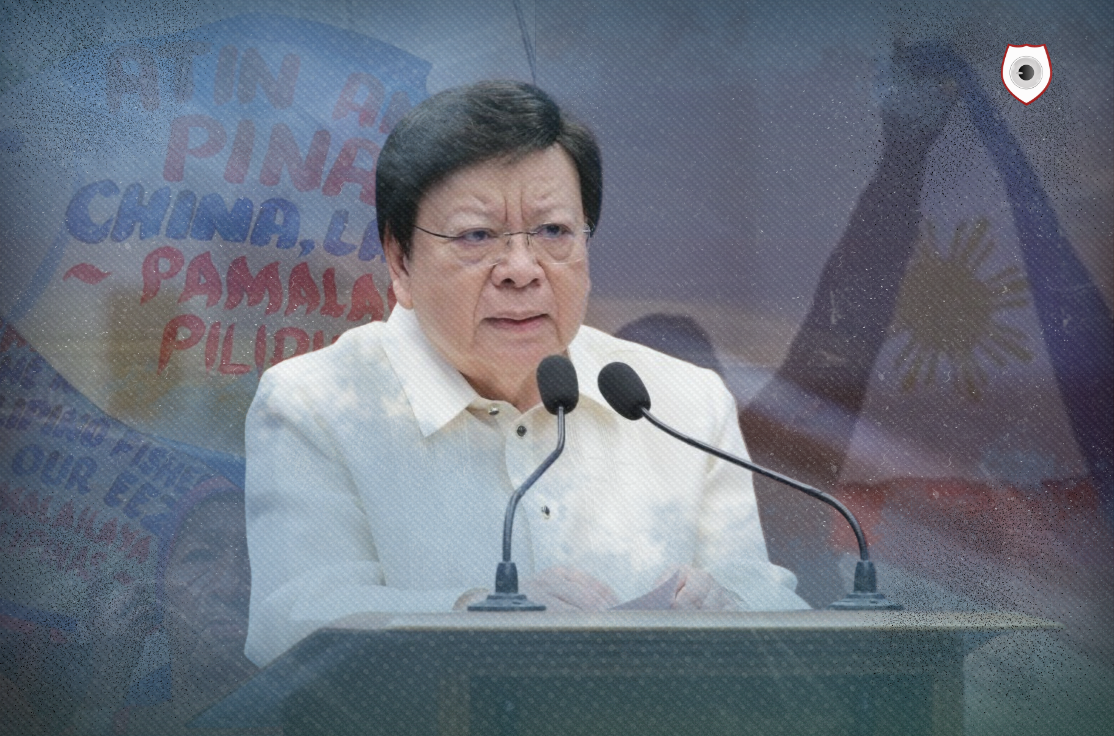
“I pronounce you guilty of treason already,” was what Sen. Rodante Marcoleta said to retired Supreme Court Senior Associate Justice Antonio Carpio last Feb. 17, claiming that the senator no longer needed to file a treason case against him since he was “guilty already.”
The retired Senior Associate Justice retorted by reminding Marcoleta that treason cannot be committed during peacetime, stressing that the penalty can be imposed only when the Philippines is at war.
Under Article 114. paragraph 1 of the Revised Penal Code (RPC), the law clearly states that, “any person who, owing allegiance to (the United States or) the Government of the Philippine Islands, not being a foreigner, levies war against them or adheres to their enemies, giving them aid or comfort within the Philippine Islands or elsewhere, shall be punished by reclusion temporal to death and shall pay a fine not to exceed P20,000 pesos.” Carpio emphasized that the senator would have to appeal the law first before pronouncing him guilty.
Furthermore, Carpio cited Article III, Section 22, of the 1987 Constitution, which prohibits ex post facto laws and bills of attainder: “No ex post facto law or bill of attainder shall be enacted,” to sue Carpio for treason for a decision he made after the RPC would have been amended.
As a state party to the United Nations Convention on the Law of the Sea (UNCLOS), which limits the territorial sea to 12 nautical miles, the Philippines is bound by its provisions as part of domestic law.
The discussion about treason began on Marcoleta’s TV show on Net 25’s “Sa Gananag Mamamayan” last Feb. 16, where he revisited the 2011 decision in the case of Magallona v. Ermita that Carpio wrote involving the territorial waters of the Philippines. Marcoleta claimed that the retired magistrate was a traitor of the nation after “giving away” almost 242,000 square nautical miles of the territorial sea of the Philippines.
The senator emphasized his belief that Carpio’s decision to uphold the government’s contention by limiting the Philippine territory in order to gain more from its Exclusive Economic Zone (EEZ).
Marcoleta also pointed to land features that are not part of the country’s sovereignty but are occupied by Filipinos, such as the Kalayaan Island Group, Parola, the Northeast Cay, Kota, Loatia, and Panata or Lankiam Cay.
In a statement, Carpio noted that if the Supreme Court were to uphold the contention of Magallona et al. that all islands and all the water enclosed by the 1898 Treaty of Paris lines should be included, then it would be no different from China’s nine-dash line claims. He said this would have violated UNCLOS and could have led to the dismissal of the Philippines’ arbitration case against China.
Marcoleta further suggested the possibility of “giving up” parts of the Kalayaan Island Group (KIG), which hosts a civilian Filipino community and a military outpost, noting that some features lie beyond the country’s EEZ. Philippine Coast Guard spokesperson Commodore Jay Tarriela expressed disappointment during an interview on Balitanghali, citing concern over statements that may undermine the Philippines’ position in the West Philippine Sea.
Tarriela then invited Marcoleta to the KIG for a domain awareness flight. Prior to this, Marcoleta challenged him, Carpio, and University of the Philippines Institute of Maritime Affairs and Law of the Sea professor Jay Batongbacal, who explained the validity of EEZ and refuted Marcoleta’s claim, to a friendly debate.
Carpio accepted the challenge and proposed a two-part agenda for the discussion: first, whether the West Philippine Sea has a legal basis; and second, whether the maritime features of the Kalayaan Island Group form part of it.
Carpio views the proposed debate as an opportunity for a public discussion on national sovereignty and maritime security.