Written By Yna Belen E. Bargo | December 1, 2025

Written By Yna Belen E. Bargo | December 1, 2025
“YOUR feelings are valid.” This statement has received growing popularity in today’s digital age, especially with the help of social media and content creators. While freedom of expression is a fundamental human right, it loses its moral value when it becomes a tool for spreading misinformation, hatred, or ignorance under the immunity of opinion or expression.
Our generation, the youth, has turned freedom of speech into a demand that every feeling be treated as truth, sacrificing reason for entitlement. The obsession with validating their emotions has twisted meaningful discourse into a playground for self-indulgence and emotional exhibitionism.
Freedom of expression has existed for centuries yet modernity has normalized freedom of expression to the point of abusing it. In today’s digital age, people are encouraged to voice out their thoughts openly without any regard for accuracy, empathy, or responsibility. For example, a simple comment on someone’s appearance online can be detrimental no matter how indifferent it could be. It could also be a backhanded compliment that indirectly harms the person, such as stating that “I wish I had your confidence.” Then, when they’re confronted about their statements, they invoke freedom of speech as a shield to excuse their behaviour.
The culture of constant posting and commenting has made expression less about meaningful communication and more about self-importance. We confuse being outspoken with being right and the louder someone is, the more attention they gain.
Our generation believes that every opinion is equally valid. This belief undermines intellectual discourse and critical thinking, leading them to conclude that any disagreement is mistaken for disrespect. The entitlement of today’s generation believes that one deserves special treatment, attention, or validation simply for having an opinion or feeling. Respecting one another’s right to speak does not mean respecting every idea as correct or useful. Civilized dialogue demands that opinions be informed, reasoned, and accountable.
Exposing the younger generation to this normalized, uncritical validation of every feeling poses a threat to their well-being. The resulting behavior is more grave than it may seem and hinders the development of critical thinking and accountability, leaving them ill-equipped to handle the complexities of the outside world.
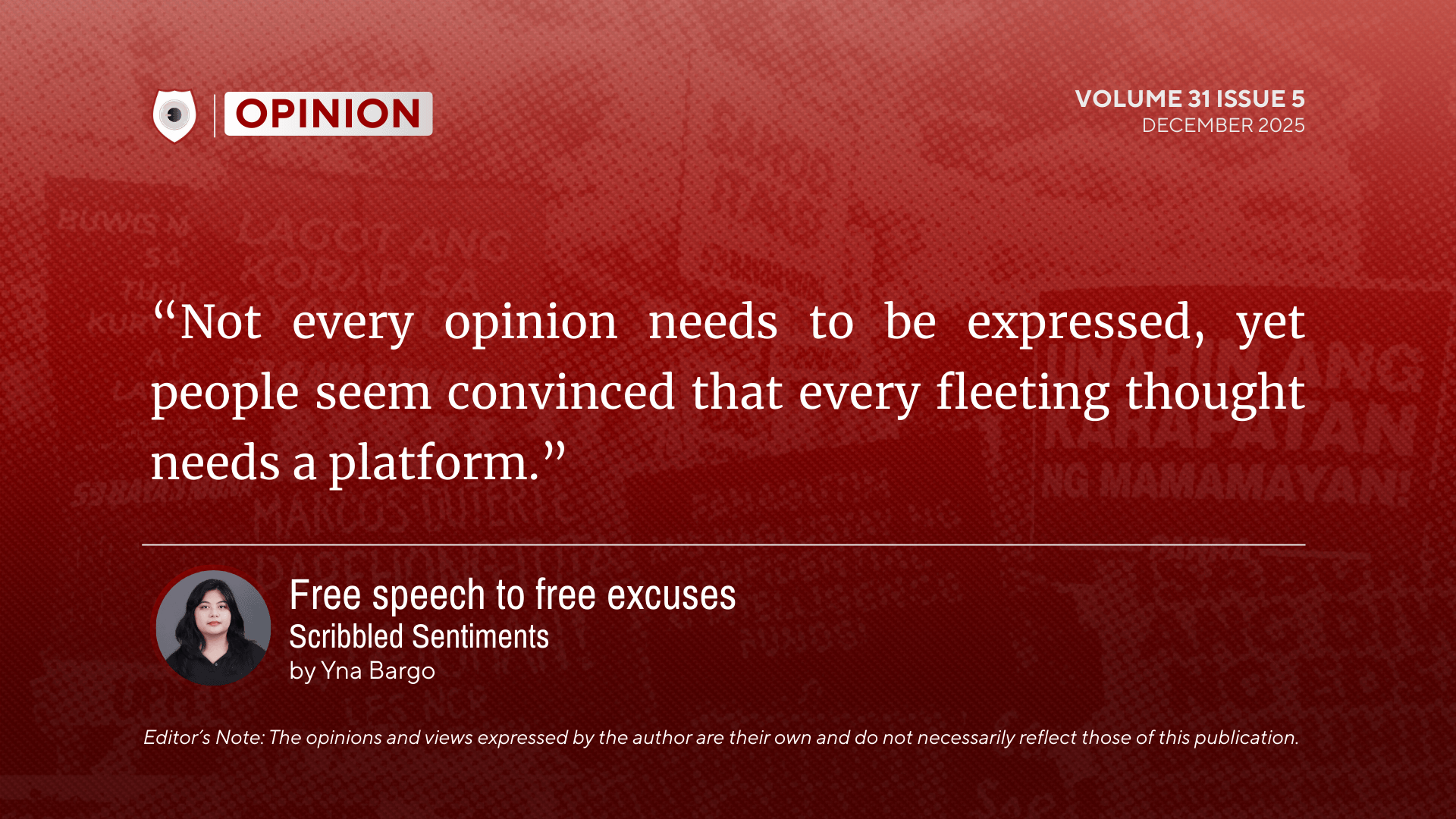
Not every opinion needs to be expressed, yet people seem convinced that every fleeting thought needs a platform. Even the right to speak has become a demand to be heard and risks becoming a weapon of ego. Expression has become performative, and individuals mistake emotional oversharing for authenticity. Every minor frustration or personal issue is broadcast as if it has some profound importance. Many individuals today forget that freedom of expression was meant to protect meaningful discourse, not to justify self-centered outbursts. This obsession with being heard reflects not confidence but insecurity disguised as boldness. We need to learn that not all opinions are valid and not every form of expression deserves protection.
This growing sense of entitlement is dangerous because it blurs the line between expression and imposition. People no longer speak to understand but to assert. In this environment, genuine communication suffers, as humility and open-mindedness are replaced by the desire to prove one’s feelings right. Reflection, not reaction, is what preserves the dignity of expression.
Not everything is debatable. But our current generation overcomplicates reality in order to accommodate or validate their feelings. Freedom of speech was established to exchange ideas to reach a concrete conclusion, not to excuse ignorance or hostility. Take a student, who just failed an exam for not studying. Later, they see a post that states, “Professors guess the students’ grades rather than computing them properly.” Because the student is feeling frustrated, they quickly agree with the statement.
“I shouldn't be restrained from expressing what I feel. That is my right.” The victim mentality saves a lot of people from facing consequences. We tend to agree with an opinion if it aligns with our emotions in the moment rather than taking an analytical standpoint. This reaction can be explained, but not justified, by emotional reasoning – a cognitive bias where people let their emotions dictate what they believe to be true. Instead of objectively evaluating whether the teacher was fair or whether their own study habits played a role, the student’s current emotional state drives their action to agree with the opinion. We paint ourselves as a victim of the system, deeming the workload “too much,” and avoid confronting the consequences of our actions. In other words, our feelings override rational thinking, leading us to accept an opinion that aligns with how we feel rather than what is true.
The entitlement of some people to prioritize feelings without any second thought threatens public conversation. Some overemphasize self-expression while undermining self-reflection. Freedom of speech is vital but it must be protected not by silencing those whose opinions differ but by ensuring that the speech contributes to constructive dialogue rather than trivial grievance.
Ultimately, freedom of expression was never intended to protect ignorance or to excuse avoiding facing the consequences. It was intended to promote deliberate discussion based on logic rather than assumptions. When opinions are elevated simply because they are emotionally charged, comfort and entitlement take precedence over the facts. Until society learns to differentiate between feelings and facts, expression will be mistreated and maturity will continue to be stunted. Real progress begins not with louder voices but with the courage to think critically, take responsibility for one's actions, and speak with purpose rather than emotion.
Volume 31 | Issue 6