By Ashley Catarroja | September 21, 2026

By Ashley Catarroja | September 21, 2026
“Ang humamak na magmahal sa kabila ng kamahalan, maituturing ba na katapangan o kahibangan?”
In an economy where we have learned to work just to survive, scarcity becomes an invisible chain that keeps us from experiencing things deemed too expensive
“Kasi mahal.” Somehow, that same word has seeped into the way we choose to love.
They say, “mahal magmahal.” That love is a luxury, something so expensive that only those privileged enough to afford it can freely choose.
When Esremborak, a five-member ukulele rock band, released “Mahal Magmahal” and the song went viral, it became more than just another song added to a playlist. It became an eye-opener, drawing questions and conversations about how deeply our economic realities influence the way we live, choose, and love.
For so long, we have been accustomed to hearing that love can overcome anything. “Basta mahal niyo ang isa't isa.” We grow up with the idea that as long as two people have each other, they can survive whatever life throws at them. We romanticize building a family despite financial struggles, choosing love even when there is barely enough to get by, and staying together through what Gen Z now calls the “zero days.”
And maybe we can.
But can love also silence every growl of an empty stomach? Can it make us forget the meals where food meant for one has to be divided among an entire family? Can it make us look away from the holes in our shoes and clothes because the money has to go first to the rice that will be served on the table?
These are not metaphors, but realities for families living through scarcity, because love does not exist in a vacuum. It exists alongside unpaid bills, grocery lists, tuition fees, transportation costs, medical expenses, and the constant calculation of what can be sacrificed today so there will still be something left tomorrow.
But if living itself were not so difficult, if the economy were not constantly struggling, if inflation were not eating away at what we earn, if basic necessities did not already feel like luxuries — would we be free to love?
It is easy to tell people to “choose love” when you are not the one counting the remaining bills.
It is easy to romanticize sacrifice when you are not the one skipping a meal, dividing one viand among an entire family, or postponing a basic necessity because there is simply not enough money.
When wages struggle to keep pace with the cost of living while opportunities and wealth remain unevenly distributed, even the freedom to choose becomes tied to what one can afford.
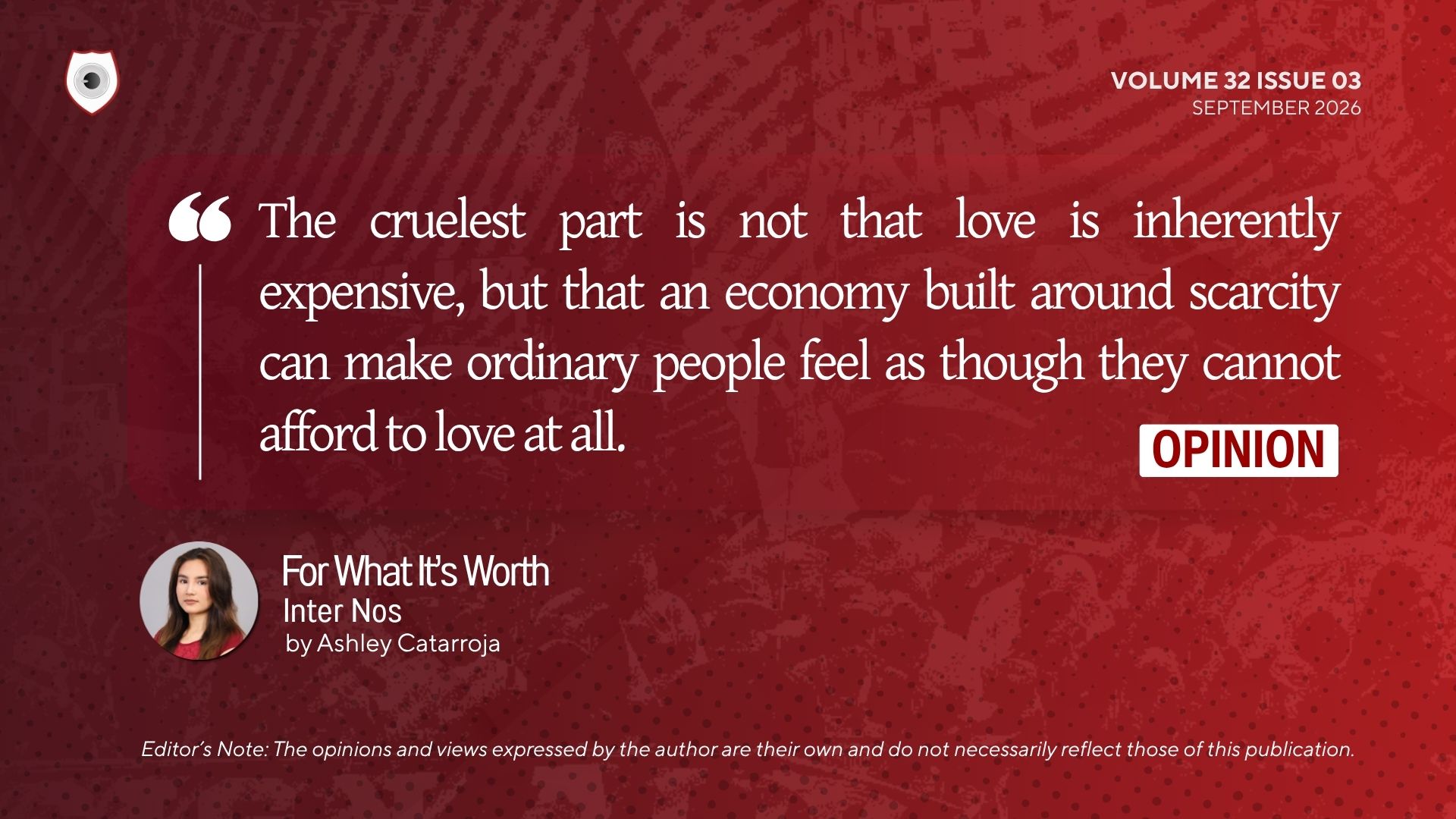
The cruelest part is not that love is inherently expensive, but that an economy built around scarcity can make ordinary people feel as though they cannot afford to love at all.
This is why “mahal magmahal” becomes more than a romantic phrase because love demands more than feelings, it demands time, responsibility, security, sacrifice, and sometimes, the ability to provide — not necessarily a luxurious life, but a life where survival does not always have to come first.
Yet does that mean those who continue to love despite hardship are delusional?
To someone who values stability above all else, it may seem that way. After all, it is easy to believe that love can overcome anything when we have never had to experience what it truly demands. But once we have felt the weight of unpaid bills, sacrificed our own needs for someone else, or witnessed how difficult it can be to build a life when there is barely enough to get by, choosing love despite all of it may begin to seem less romantic and more like a delusion.
But calling it “kahibangan” is also too easy.
There are people who choose to love not because they are unaware of the hardship, but because they have already seen it and still believe that the person beside them is worth choosing.
There are also those who choose stability not because they are cowards, incapable of loving, or afraid of commitment, but because they understand what it means to be responsible for another person.
And perhaps that is where the real question lies: Is choosing stability over love cowardice, or is choosing love despite instability bravery?
Maybe it is neither. Maybe it is simply a matter of choosing what we are willing to live with.
We do not get to choose the circumstances we are born into or decide whether we will grow up with abundance or scarcity, whether the economy will make our lives easier or harder, or whether the things we need today will still be affordable tomorrow.
But we can decide what we do with the circumstances we have.
Some may choose to love through hardship. Others may choose to wait until they are financially ready. Some may choose both, trying to build stability while building a relationship at the same time. And there are those who may realize that they cannot afford to carry both.
None of these choices exist without consequences.
In the end, the real question was never whether love can survive poverty. We already know that it can. People have loved through wars, recessions, empty kitchens, and zero days long before we gave those struggles a name.
The question is whether we are prepared for what that love asks from us.
We might be able to survive with love, but should survival always be the standard we ask love to meet?
Mahal will always carry two meanings: something we love and something that costs us.
And whether we choose to pay that price or walk away from it is not a measure of our bravery or our foolishness. It is simply a choice we must be willing to live with, and not one we spend the rest of our lives regretting.
Volume 32 | Issue 3