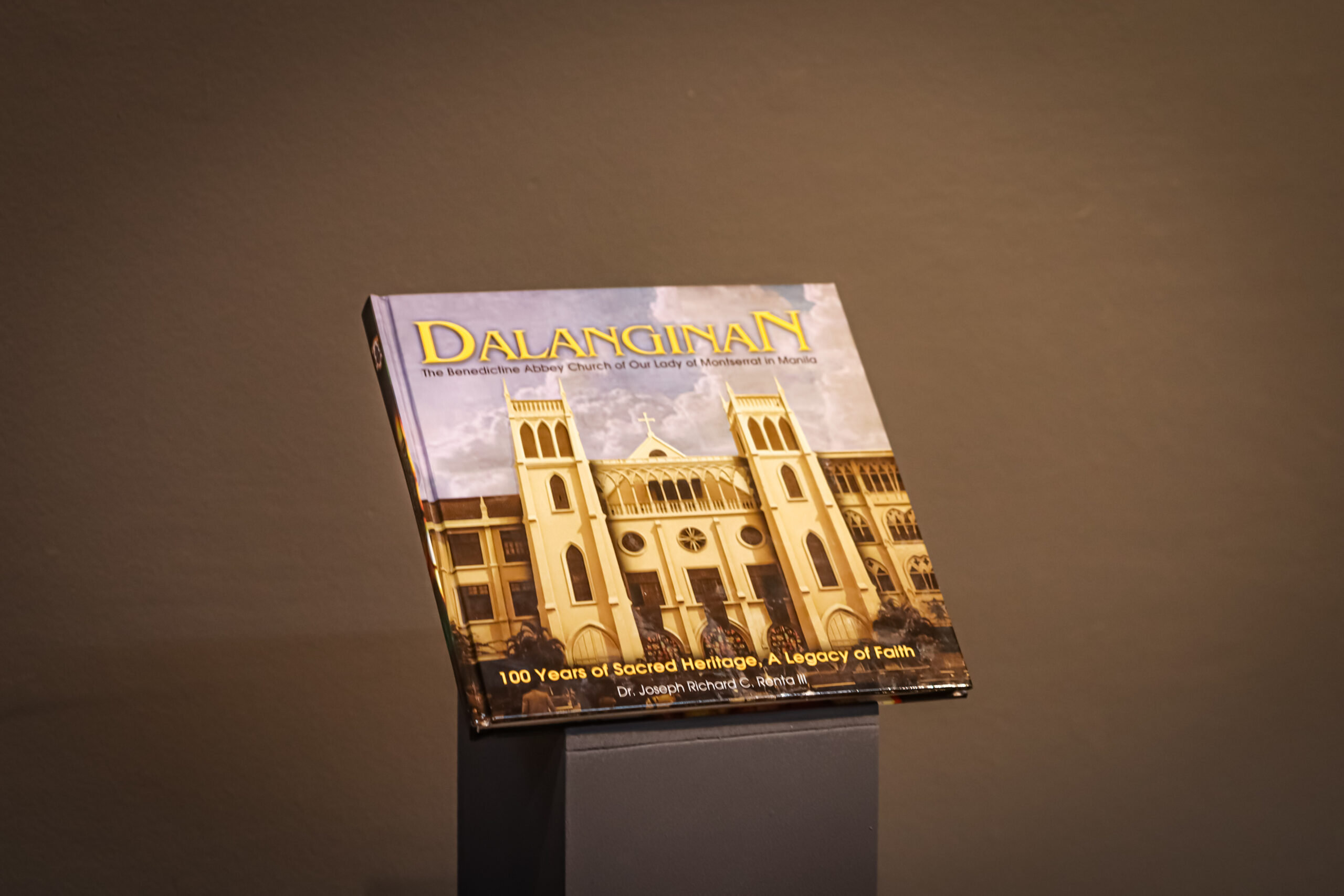
DEDICATED for one hundred years, the Abbey Church of Our Lady of Montserrat has stood at the heart of Benedictine life in San Beda. Since 1926, the church has witnessed generations of prayer, formation of hearts, and establishment of a community that all serve not only as a place of worship but also as a spiritual anchor for an institution grounded in faith and discipline.
Displayed at the Our Lady of Montserrat Building in SBCA, the Dalanginan Exhibit commemorates a century of dedication reflected in the Abbey Church’s history, traditions, and lasting impact on the life of the Benedictine community. Open from Jan. 15 to March 15, 2026, the public may view the curated artifacts and archival materials that illustrate how Ora et Labora has slowly and quietly shaped the identity and direction of San Beda over the years.
As Fr. Gerardo Ma. De Villa, OSB, stated in his opening remarks: the Dalanginan Exhibit is presented as both a prayer book and a showcase that underscores the importance of prayer as an integral part of daily life, particularly within institutions deeply rooted in religious tradition, such as San Beda and the Benedictine Abbey. This invites viewers to gain a deeper appreciation of the power of faith and its role in shaping both personal and communal religious experiences.
Foundation of Faith
Bringing together photographs, archival documents, old books, and symbolic objects used by Benedictine monks, the exhibit situates the Abbey Church within its historical and institutional context. The materials trace to the development of Benedictine life alongside the growth of San Beda, which perfectly shows how religious practice and education evolved together over time.
A series of displays focuses more on the early years of the Church, beginning on Jan. 13, 1926. During the said period, the Philippines was under American colonial rule, and the Benedictine community was entering a defining chapter, marked by the elevation of their priory to an abbey, the election of Rt. Rev. Raimundo Salinas as its first abbot, and the completion of their church and school in Mendiola, Manila.
The church was designed by Swedish architect George Asp in a neo-Gothic style, originally characterized by its simple ornamentation. Subsequent additions, including murals and a retablo designed by Fr. Lesmes Lopez between 1931 and 1937, reflected the growing identity of the community it served. Renovations, documented in the exhibit, illustrate how the structure adapted to the passage of time while remaining true to its original purpose.
Rather than isolating the church as a historical monument, Dalanginan places it within the momentum of everyday Benedictine life. It documents how the Abbey Church has served as a setting for liturgical celebrations, academic rites, ordinations, and funerals, or simply moments that shaped both individual lives and the collective memory of the Bedan community.
By grounding the exhibit in significant events and materials, Dalanginan avoids idealizing the past. Instead, it presents the Abbey Church as a living institution — one that has remained relevant not by resisting change, but by holding fast to its core discipline and practice.
Living Legacy of Faith
A century may have passed since the Abbey Church of Our Lady of Montserrat first opened its doors, yet its presence continues to echo through the halls of San Beda. As visitors walk through the displayed archives, they are invited to see the Abbey Church not merely as stone and murals, but as a living witness to generations of devotion, learning, and service.
In celebrating this milestone, Dalanginan reminds us that institutions built on faith form the foundation of our Benedictine community and demonstrates how “Ora et Labora” continues to guide, inspire, and shape the identity of San Beda.