ABS-CBN News brought its Campus Patrol roadshow to Manny Reyes Hall at SBCA last Oct. 15 to promote media literacy. Organized by the Department of Communication and Media Studies under its Chairperson, Gino Antonio Rivera III, students were encouraged to verify, reflect, and act responsibly online. Executive Optical and Huawei presented the event in partnership with SBCA and iWant.
The program combined talks from ABS-CBN News personalities, including Erik Tenedero, Dabet Panelo, Adrian Ayalin, and Ariel Rojas, with games and performances by the boy group 1621 and singer-songwriter Trisha Denise.
Students also took on a “Being a Reporter” challenge, getting first-hand experience in front of a microphone and camera as they delivered the news themselves. Andrea Taguines, Michael Delizo, and Ganiel Krishnan, multimedia reporters from ABS-CBN News, hosted the program.
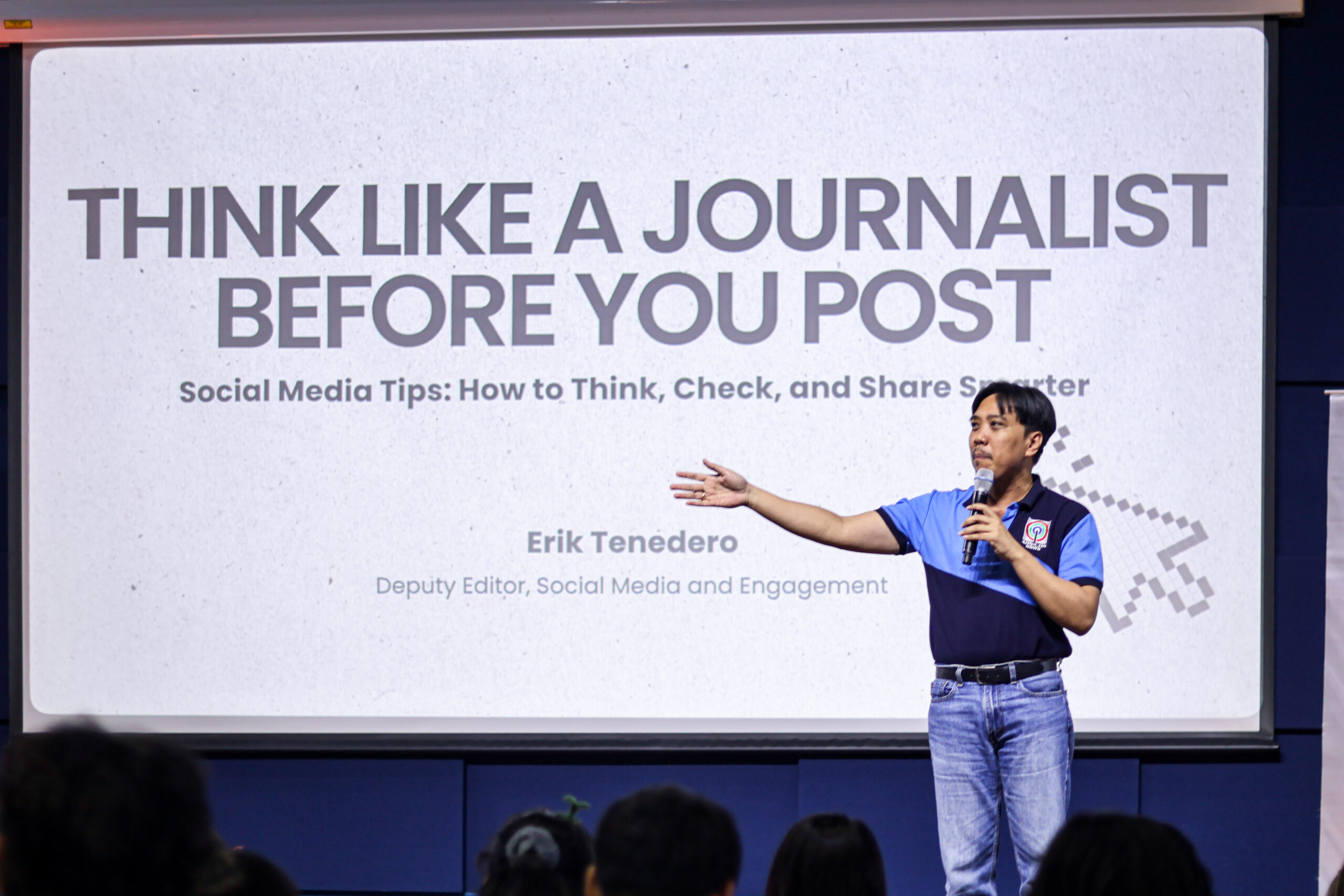
Think Like a Journalist
Erik Tenedero, deputy editor for social media management at ABS-CBN News, commenced the event with a practical framework for students: pause and ask what a journalist would ask before hitting “post.”
Tenedero warned, “online trends that ask for personal details, such as the recent school ID trend, bits of information can add up to identity theft.” Reminding students that private or “dump” accounts do not guarantee privacy, as content can still be saved or leaked.
He also urged the audience not to fall for rage bait or join online pile-ons, saying outrage is often monetized by platforms and content creators. Tenedero left a test for the audience to ponder upon, “Would you say it out loud in front of a crowd?”
On misinformation, his rule was simple, “verify first, share second, by asking who posted something, where and when it happened, and whether it can be independently confirmed”.
Citizen Journalism and Verification
Dabet Panelo, research and training officer of Bayan Mo, i-Patrol Mo (BMPM), ABS-CBN's citizen journalism and verification unit, explained how ordinary users help document floods, dam conditions, and community stories, and also heartwarming moments that go viral.
“But posting something does not automatically make one a journalist,” she said. Panelo stressed that Journalism is a process of verification. Through BMPM, this verification process is evident. The citizen journalism arm of ABS-CBN showcases this process as they contact uploaders, check locations and details, ask permission to use content, and require original timestamps of the incident.
She also showed examples of AI-generated and misleading posts, including a billboard in Guadalupe that appeared to be on fire and prompted a response from firefighters. Panelo asked students to “include the location, date, time, and credit to the owner when sharing disaster-related content.”
Misinformation, Disinformation, and Context
Anchor and reporter Adrian Ayalin distinguished misinformation from disinformation. He shared that the former consists of information shared without intent to deceive, while the latter is deliberately spread for profit or an agenda. He also stressed that disinformation poses a greater danger compared to misinformation.
Ayalin, who covers justice and human rights, showed how the network uses social media explainers to give context to complex stories. Some examples he showcased included explaining the alleged P110 million in seized cash in everyday terms for viewers, while another broke down a Supreme Court ruling on death benefits and the rights of non-marital children.
“Whether a story concerns a court decision or a fishball vendor… Journalists must make it understandable and keep the focus on people,” he said.
Why fake news spreads
Ariel Rojas, resident meteorologist of ABS-CBN News, showed how weather touches every part of daily life, from agriculture, health, and education to transport, showing why accurate information about it matters.
“With some 98 million Filipinos online and 96 million of them on social media. False information can reach a vast audience within minutes,” he said.
Rojas went on to narrate why fake news travels so well: simple, fear-driven content, or rage bait, tends to go viral, and many people share it with good intentions. Social media algorithms, he noted, “reward emotional posts, feeding echo chambers in an economy built on attention."
Fake news is typically exaggerated, algorithm-friendly, and emotional, while accurate reporting is calm, nuanced, and data-driven. Exaggeration, inconsistencies, and a questionable source or poster are warning signs. His advice for encountering fake news: “validate it, do not engage with it, and report it.”