MANY older generations were raised to endure silently. While that may have been their reality, it should not automatically define ours.
Awareness does not equal fragility. Speaking up does not mean surrendering our strength.
When Robin Padilla questioned how young people spoke about mental health, what many of us heard was not genuine concern — it was dismissal. We heard the familiar accusation that the youth are “too sensitive,” that our strengths are dismissed as drama and our pain as somehow artificial.
Calling out anxiety, depression, and emotional trauma is not a trend. It is not “arte” or exaggeration. It is not a weakness manufactured by social media. It is the language of a generation that refuses to romanticize suffering.
What has changed is not the existence of suffering; it is the willingness to acknowledge it.
Students today juggle academic pressure, financial uncertainty, family expectations, and the exhausting performance culture amplified by social media. We are constantly told to achieve more, be more, prove more, while being given fewer safe spaces to fall apart.
Burnout has become ordinary, rest is labeled laziness, and vulnerability is mocked. Then, when we finally admit we are struggling, we are accused of being “dramatic.”
Let’s be clear: mental health is health. We do not shame someone for having asthma or question the legitimacy of diabetes. We do not simply tell someone with a broken bone to endure it. Yet, when it comes to anxiety, depression, and the like, compassion suddenly becomes optional.
Mental health is not about being overly sensitive, it is about acknowledging that emotional well-being is just as vital as physical health.
We are tired of being told that we are soft simply because we are honest.
The youth are not fragile — we are fatigued.
We grew up in a pandemic. We watched our education shift overnight. We live in a country where economic survival is a daily battle for many families. We scroll through endless comparisons and unrealistic expectations.
If we speak about our struggles more openly, it is not because we are weaker than those before us; it is because we recognize that pretending is no longer an option.
If adults were forced to stay silent about their wounds, why insist that we do the same? Why pass down silence like an heirloom when we can pass down empathy instead?
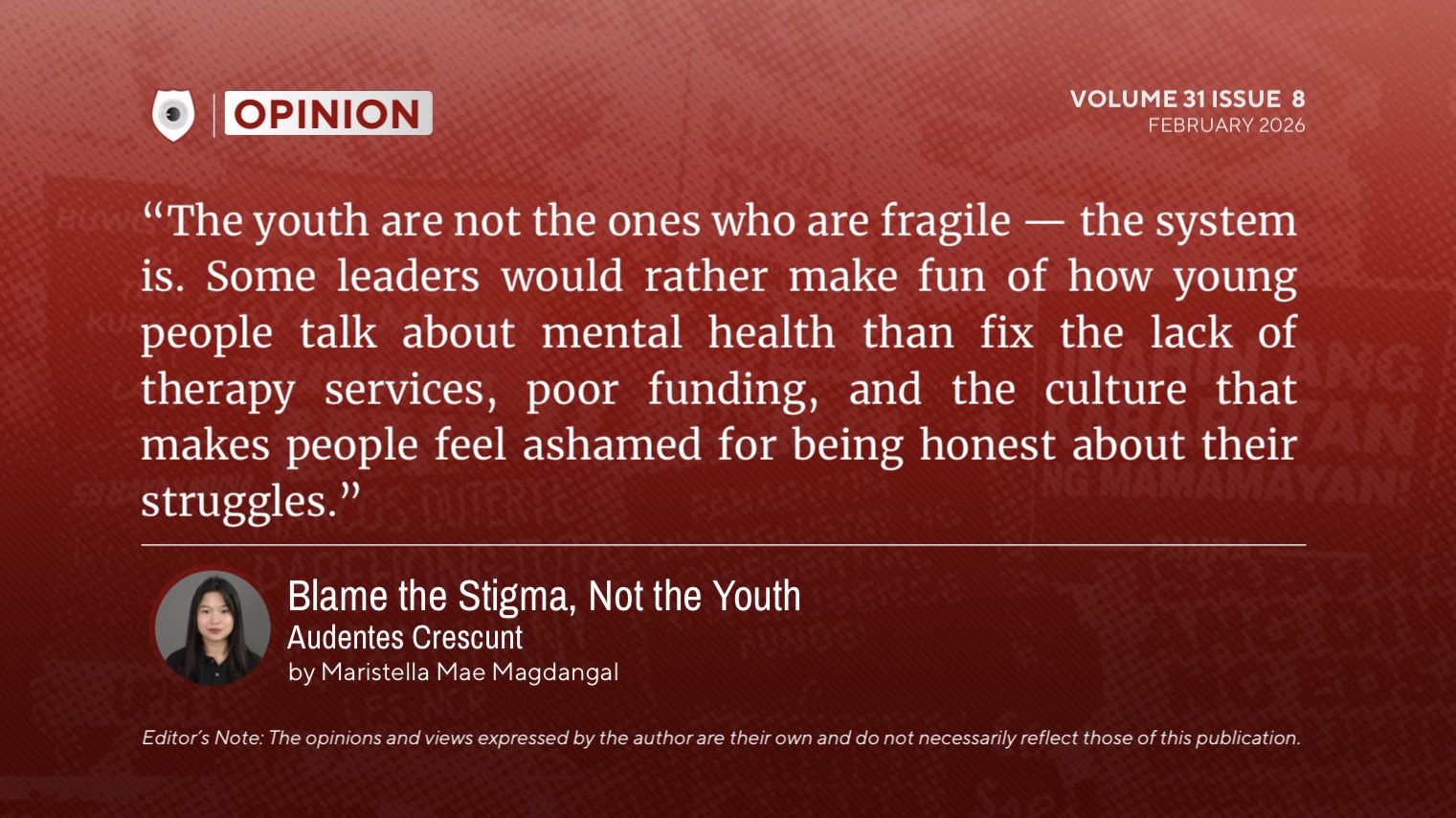
The youth are not the ones who are fragile — the system is. Some leaders would rather make fun of how young people talk about mental health than fix the lack of therapy services, poor funding, and the culture that makes people feel ashamed for being honest about their struggles. A society that mocks vulnerability instead of addressing it reveals its own weakness.
We will not apologize for speaking up.
We are not the problem with naming our pain. The problem is a society that still confuses vulnerability with weakness.
The youth are not the problem. The stigma is.